
Three identifiers before any strategy
Read the full game title, the provider name and the mode selected on the screen. A lobby title may shorten the name, so open the game’s own information panel as well. Original Plinko is the edition tested here; a related title, numbered sequel or special mode is not automatically covered. The provider tells you who made the game, while the operator or app publisher tells you who provides the account. Those are different roles.
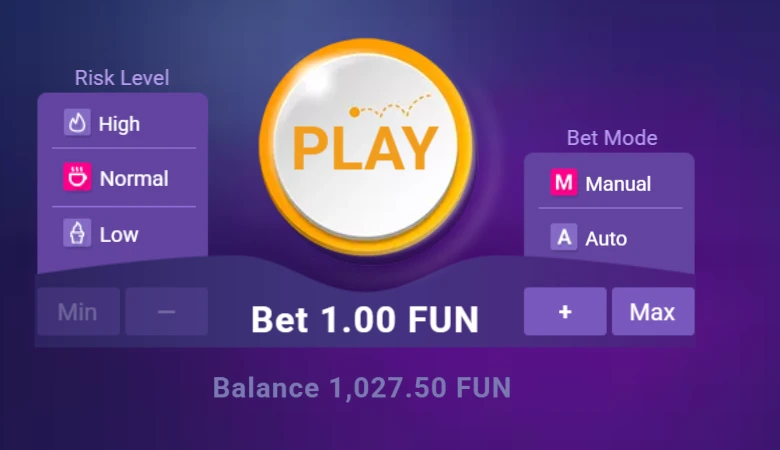
Next, record the number of rows and the risk label. Our captured interface calls the middle option Normal. Translations may use a local equivalent, but a table should settle the ambiguity. A guide that merely says “medium risk” without its row count and multipliers leaves too much unspecified. Do not select a setting by colour alone: colours are design choices, not stable mathematical identifiers.
Finally, note the unit and stake controls. A balance of 500 FUN is not €500. A minimum stake or an Auto control may differ between wrappers or builds. The 500 FUN starting bank and 64 FUN cap in our simulator are editorial comparison settings; they are not assertions about the minimum deposit or maximum bet at a real-money operator. Keeping that distinction prevents a test setup from becoming a false product specification.
The 16-row table we actually captured
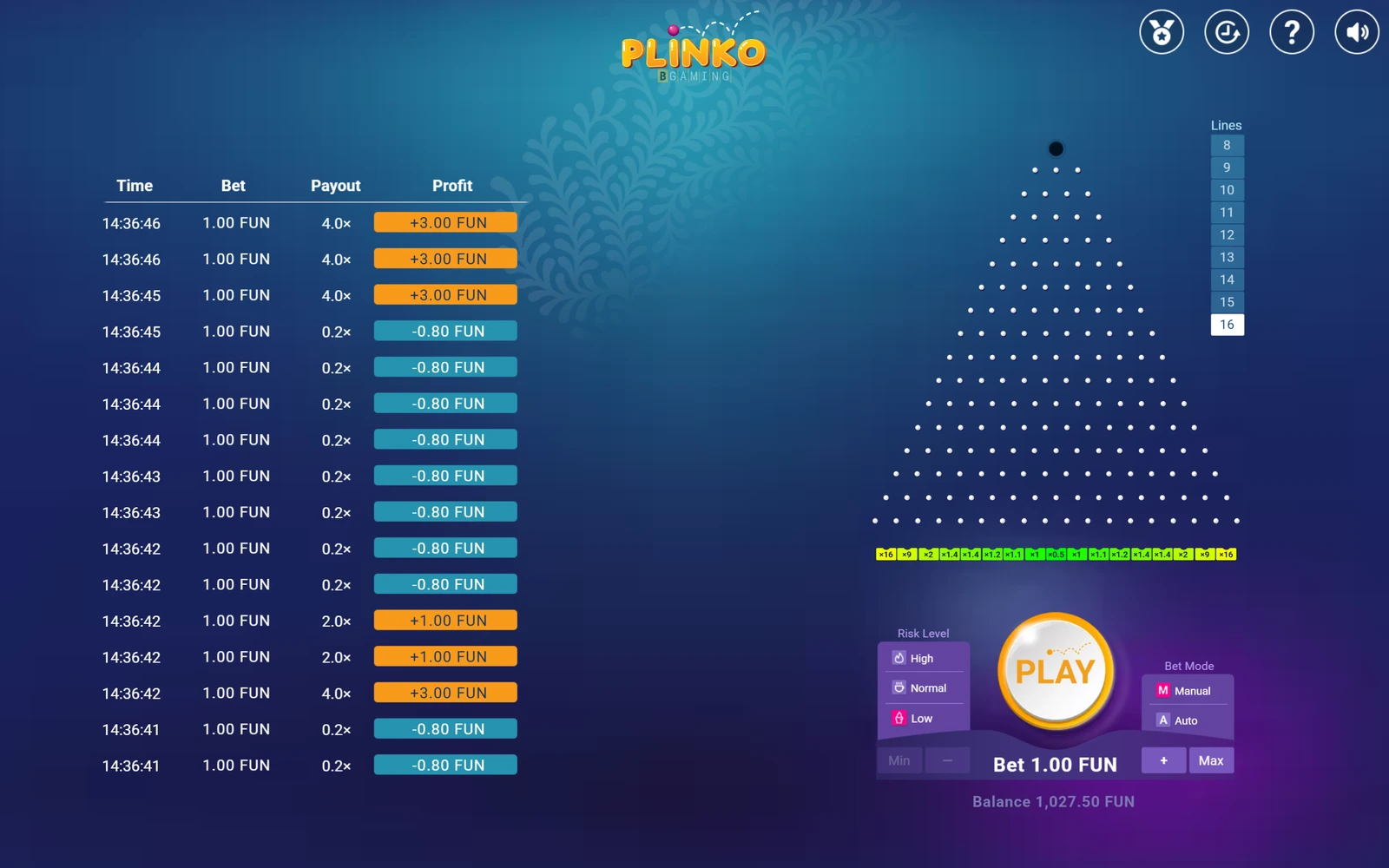
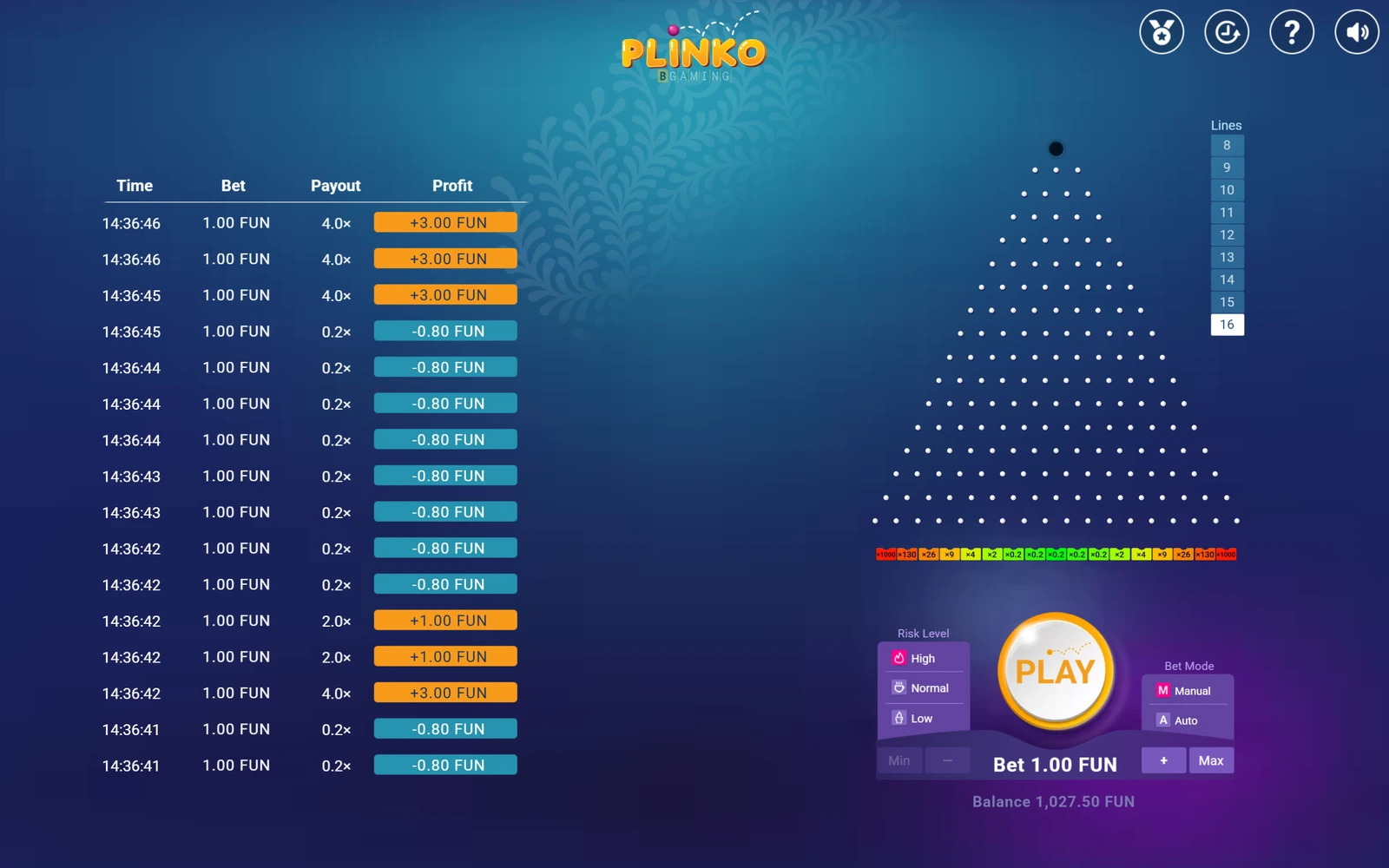
At 16 rows there are 17 landing pockets, indexed from 0 to 16. The exact centre is pocket 8. The two edges are pockets 0 and 16. The captured BGaming tables are symmetric, so matching pairs have the same multiplier. For a quick visual check, compare both an edge and the centre. For a reliable match, read all 17 values in order.
Low has a 0.5× centre, 1× neighbours and 16× edges. Normal has a 0.3× centre, 0.5× neighbours and 110× edges. High has five central pockets paying 0.2× and edges paying 1,000×. These are sharply different reward maps applied to the same 16-row landing probabilities. They are not three levels of skill and do not tell you how hard to press Play.
A table maximum describes a possible gross multiplier, not the largest net profit in every situation. A hypothetical 2 FUN drop at 110× returns 220 FUN and adds 218 FUN net. Whether an account applies a payout ceiling would be a separate rule to read. Our capture does not establish every operator’s account limits, and our 3,000 drops need not include a table maximum.
| Setting | Centre | Immediate neighbours | Each edge |
|---|---|---|---|
| Low | 0.5× | 1× | 16× |
| Normal | 0.3× | 0.5× | 110× |
| High | 0.2× | 0.2× | 1,000× |
Check the intermediate pockets, not just the jackpot
Two 16-row tables can share 1,000× edges while assigning different returns to pockets 5, 6 or 7. Those intermediate positions occur far more often than the extreme edge. In our verified table, High pocket 5 pays 2× while Normal pocket 5 pays 1.5×; pocket 6 pays 0.2× on High but 1× on Normal. With a 10 FUN stake, that pocket-6 difference means −8 FUN on High versus break-even on Normal. The same ball position produces a materially different account change.
A version note should include when the table was observed. Interface updates can change controls, labels or available configurations. If your screen no longer matches ours, save the new rule screen and treat the mismatch as a reason to recheck. Do not combine a current screenshot with an old table just to keep a comparison looking complete. The values on this page describe the demo captured on 30 October 2026.
Which parts of a strategy transfer to another version?
A staking instruction can be portable while its result is not. “Keep the stake fixed” is understandable in many games. The curve produced by that instruction depends on the actual outcome sequence and multiplier table. Copying our fixed-stake net result onto another game would combine an instruction from one product with evidence from another. The same problem affects claims about a profitable historical predictor.
Progressions need a definition of winning. In our replay a net profit resets Martingale, a net loss raises it and exact break-even keeps the level. If another version has many 1× results, it will hold the level more often. If it has different small positive returns, a reset can leave accumulated losses unrecovered. A shared system name does not make the financial behaviour identical.
Probability claims are even more specific. The binomial vector on our odds page describes the verified equal-probability 16-step model. A different mechanism cannot be assumed to have that vector because its animation resembles a pin board. Look for the version’s own rules. An animation is a presentation of the result; measuring its visible bounces is not a substitute for verifying the probability model.
Eight rows and sixteen rows are not one probability
In an equal-left/right model, eight rows give 2^8 possible paths and nine pockets. One specific edge has probability 1/256, and either edge combined 1/128. At sixteen rows those numbers become 1/65,536 and 1/32,768. This calculation explains how the row count changes rarity. It does not supply an eight-row payout table or prove the RTP of a version whose rules have not been read.
A more frequent edge is not automatically a better-value bet because its multiplier can also be smaller. Expected return requires every pocket’s probability multiplied by its payout, then summed. Comparing the frequency of a headline prize while ignoring its amount and the other pockets leaves out most of the calculation. The probability calculator can explore row counts mathematically; the empirical strategy study remains the specific 16-row game.
Browser demo, app and physical board are different questions
A browser and an app can display the same underlying provider game. That does not prove they share a login, wallet or withdrawal conditions. Conversely, two apps with almost identical ball art may be unrelated games. Separate how the software is delivered from what game it implements. An installation is not required for the public BGaming FUN demo embedded in this guide.
Physical and televised Plinko boards add other variables: the release position, physical board and event rules. Advice about dropping a real chip from the centre is not evidence about the digital game’s next result. A television prize of €50,000 or a converted foreign amount also does not establish the maximum available in this software. Identify the event before answering a question about a spectacular win.
An app that promises withdrawable rewards raises account questions that a free game does not. It needs its own publisher and conditions check. Our app guide explains how to separate the displayed balance from a withdrawal claim. The version identifier here deliberately stops at what can be read on the screen; it does not certify an app’s business practices.
Make a useful side-by-side comparison
Use two columns and give each game its own identifiers. Copy title, provider, rows, risk label and all payout values. Then compare the unit, minimum editable stake and available controls. Mark an unavailable value as unknown rather than carrying it across from the first column. This takes longer than comparing only the largest multiplier, but it prevents most false equivalences.
For a numerical comparison, hold the total intended exposure constant where possible. One game at 1 FUN per drop for 100 drops and another at 10 units per drop for 100 drops are not equivalent budget tests. Even with matched exposure, a short sample can be dominated by one rare pocket. Record every attempted and completed drop rather than saving only the best screenshot.
When a setting changes, start a new labelled segment in your notes. Do not blend eight-row Low and sixteen-row High into one claimed RTP for a particular configuration. A mixed-session total can describe the money returned by that session, but it cannot identify the behaviour of one setting. Our study keeps three separate 1,000-drop samples precisely so each result remains attached to its actual table.
What to do when the version remains unknown
You do not need to solve an unidentified game by guessing. Keep the screenshot and locate the rules or information button. If the provider name or payout table cannot be read, the honest result is “not identified”. The general formula stake × multiplier − stake still explains a displayed payout, but our historical graphs should not be used as evidence about that unidentified product.
For a controlled practice exercise, open the identified original demo and match the 16-row table here. The illustrated controls show what to change. You can then compare the ten rules in the simulator with a clear connection between game, table and results. That connection is more useful than a universal “best Plinko” label unsupported by comparable evidence.
How to read provider-specific searches
A search such as “Plinko demo Hacksaw” asks for a particular provider, not any ball-drop game. This site’s embedded game is BGaming Original, so it does not fulfil that provider identity by relabelling the frame. The same applies to a named operator or a game inside a different entertainment product. Start with the requested product identity, then decide whether our general stake explanations are relevant.
For a reproducible comparison, save a compact record with title, provider, version or observation date, rows, risk, unit, all multipliers and the test rule. A second reader should be able to rebuild the same inputs from that record. If one entry is missing, label it unknown. A shorter but accurate version record is more useful than a complete-looking record assembled from different products.