
What one Plinko round actually is
A round of Plinko has exactly three moving parts: a stake, a ball, and a result. You commit a stake before anything moves. The ball is released at the top of a triangular field of pegs and bounces left or right at each row until it settles in one of the pockets along the bottom edge. Each pocket carries a multiplier. The game then pays out your stake times that multiplier, and the round is over. There are no decisions after you press the button, no bonus screens, and no way to influence the ball once it is in motion.
The version here is BGaming Original Plinko in its public FUN demo. FUN is virtual and cannot be withdrawn. You can learn the visible controls and table without opening a funded account. A real-money operator’s version still needs its own rules and account checks; we do not assume every deployment has identical settings simply because the title matches.
One round is also completely independent of the next. The ball does not remember where it landed, the pockets do not heat up or cool down, and the game does not owe you a good result after a run of bad ones. Everything you can control happens before the drop: how many rows the ball crosses, how spread out the payouts are, and how much you stake.
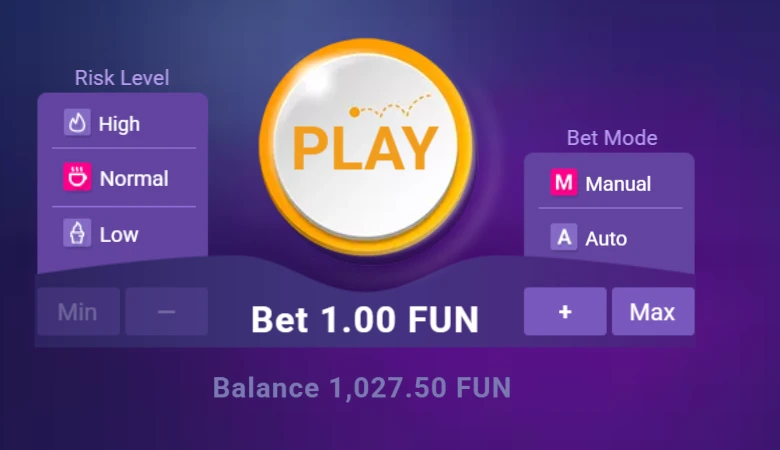
The controls: Lines, Risk Level and bet size
The interface gives you three settings and two play modes. Getting comfortable with them takes a minute, but each one changes the game in a specific, knowable way.
Lines sets the number of rows of pegs, adjustable from 8 to 16. More rows mean more pockets along the bottom and a wider spread of outcomes: at 16 rows there are 17 pockets, and the ball is far more likely to finish near the centre than at either edge. The centre pockets pay the smallest multipliers and the edge pockets pay the largest, so adding rows mostly adds granularity to the same shape of distribution rather than making the game looser or tighter in your favour.
Risk Level — Low, Normal or High — swaps the entire payout table while leaving the ball physics untouched. The probability of landing in any given pocket is identical across all three risk settings at the same number of rows; what changes is what each pocket pays. Low risk compresses the table: at 16 rows the multipliers run from 0.5× in the centre up to 16× at the edges. Normal stretches them from 0.3× to 110×. High stretches them violently, from 0.2× in the middle to 1000× at the far corners. Higher risk does not mean a better chance of winning; it means a wider gap between the common small results and the rare big ones.
Bet size is below Play, with minus, plus, Min and Max controls. It scales the return for the selected table. Rows and risk also affect the outcome distribution or payout mapping, so stake is not the only choice relevant to balance changes. Read the amount before each manual test drop.
Manual and Auto modes
Manual mode plays one round per press of the Play button. This is the mode to learn in, because you see every stake, every landing pocket and every balance change individually.
Auto mode repeats the game for you. In the verified interface, Auto lets you set a number of bets and a Stop action; native cycle controls that halt automatically on a loss or profit threshold were not verified in this version, so do not assume they exist. If you use Auto, treat the bet count as your only reliable brake, and watch the balance rather than the animation.
The Play button
Play is the actual button that commits the stake and releases the ball. There is no confirmation step: the moment you press it, the stake leaves your balance and the outcome is already determined, even though the animation takes a second to show it. If you double-press or press during the animation, you may fire additional rounds at the same settings, so on a phone especially, press once and wait for the result to settle.
The stake steps we actually checked
Pressing plus from the minimum selected 1, 2, 3, 5, 10, 15, 20, 30, 50, 75 and 100 FUN. It did not offer 4, 8, 16, 32 or 64 FUN. We saved the controls without placing more bets. A textbook progression may therefore need adjustment before it can be followed in this interface. The simulator has separate cent-model and observed-demo-step settings.
Reading the result: gross return versus net
The single most important skill in Plinko is reading what a round actually paid. The game announces a return, but the return is gross — it includes part or all of your stake coming back. Your net result is the gross return minus the stake, and in Plinko the net is negative far more often than the animation suggests.
Take two concrete examples at a 2 FUN stake. If the ball lands in a 0.5× pocket, the game returns 1 FUN. That is a gross return of 1 and a net result of −1: you lost half your stake even though the game visibly 'paid' you. If the ball lands in a 9× pocket, the game returns 18 FUN, a net of +16. Both outcomes are called wins by the animation; only one of them grew your balance.
The frequency of a net loss depends on risk. At 16 rows Low has approximately 45.4% profitable drops, 34.9% break-even and 19.6% losses. Normal has 21.0% profits, 24.4% break-even and 54.6% losses. High has 21.0% profits and 79.0% losses, with no break-even pocket. A majority of High outcomes lose, but that statement does not apply to Low.
So a 'losing' round in Plinko is usually not a total loss. Twenty High-risk drops at a flat 1 FUN stake that all land at 0.2× lose 16 FUN in total from a 100 FUN balance — not 50, and not 100. Each round returns 0.2 FUN, and those partial returns add up. Any staking plan or mental budget that assumes a loss means the whole stake is gone will misjudge the game badly.
The theoretical return to player is just under 99% on all three risk tables at 16 rows — about 98.999% on Low, 98.988% on Normal and 98.976% on High. That is an average over an enormous number of rounds, not a promise for your session. It tells you the game keeps roughly one percent of turnover in the long run; it says nothing about whether your next fifty drops land above or below that line.
| Risk level (16 rows) | Centre multiplier | Edge multiplier | Rounds paying more than stake | Rounds paying less than stake |
|---|---|---|---|---|
| Low | 0.5× | 16× | ≈ 45.4% | ≈ 19.6% |
| Normal | 0.3× | 110× | ≈ 21.0% | ≈ 54.6% |
| High | 0.2× | 1000× | ≈ 21.0% | ≈ 79.0% |

Where the ball lands and why the edges are rare
At 16 rows, the ball makes 16 left-or-right bounces, and the pocket it lands in is determined by how many of those bounces went one way. That makes the landing positions follow a binomial distribution: the centre pocket is the single most likely outcome at about 19.6%, the pockets beside it are next most likely, and the probabilities shrink steadily toward the edges.
The extreme edge pocket — the one carrying the 16×, 110× or 1000× multiplier depending on risk — is reached only if all sixteen bounces go the same direction. The probability of one specific edge is 1 in 65,536, and the probability of either edge combined is 1 in 32,768. The 1000× pocket on High risk is therefore not a realistic target to plan around; it is a lottery-grade event attached to a game whose everyday action happens in the centre.
The practical consequence is that the risk setting changes the price of the common outcomes, not their frequency. On High risk, the centre pockets you will hit most often pay 0.2×, so a typical session bleeds steadily with occasional partial recoveries. On Low risk, the same landing pattern costs you far less per round, because the centre pays 0.5× and the near-centre pockets pay at or above the stake. Choosing Low risk is not a strategy for winning; it is a choice about how quickly a losing stretch erodes the balance.
The odds page explains the probabilities and the settings guide lists the complete 16-row multiplier tables. Use the simulator to compare balance paths and inspect each recorded pocket in its bet table. A short sample need not match the theoretical distribution closely.
Your first session, step by step, on desktop or phone
This first exercise is for learning the controls, not estimating RTP. Twenty results can vary substantially. Record the actual stake and return rather than expecting a prescribed curve, and keep each risk’s notes separate. On a phone, wait for the controls to settle before tapping; a second tap can start another paid drop.
- Set Lines to 16. This shows the full shape of the game, and it is the configuration the published payout tables describe.
- Set Risk Level to Low for your first drops. The compressed payout table makes it easy to see gross versus net without wild swings.
- Set the bet to the minimum with the minus button or Min. Your first goal is reading results, not chasing them.
- Press Play once and watch three things: the pocket the ball lands in, the multiplier on that pocket, and the exact change in your balance.
- Repeat for at least twenty drops, noting how often the return is below the stake. This calibrates your expectations faster than any description.
- Switch to Normal, then High, for twenty drops each at the same stake, and compare how the same landing pattern feels when the centre pays 0.3× or 0.2×.
- Only then, if you want volume, open Auto, set a small bet count, and confirm the balance afterwards against what the bet count and stake imply.

Staking plans, persistent myths and the Italian context
A staking system changes exposure and can change a particular session’s result; it does not alter the next-pocket probabilities. With base 1 and cap 64, Martingale permits seven stakes through 64 before blocking 128. Seven High 0.2× returns lose 101.60 FUN on 127 FUN turnover. Six lose 50.40 on 63 turnover but still allow the seventh stake if the balance covers it.
Other progressions fail more quietly. A Fibonacci sequence of 1, 1, 2, 3, 5, 8 turns over 20 FUN; at 0.2× returns that is a net of −16. A 1–3–2–6 cycle only delivers its advertised +12 units if all four wins pay exactly 2×, which Plinko pockets rarely do — a 1.1× return on the 1 and 3 stakes nets just 0.4, and a 0.5× on the 2 stake loses 1, for a combined −0.6. The strategies section and the Martingale page work through these systems in full, and the settings page covers how lines and risk interact with them. The short version: staking plans change exposure and realised results, not the underlying expectation.
A cluster of myths deserves a flat answer. Changing seeds, tapping the screen in bursts, or raising the stake after a run of low returns are all claimed in international forums to influence outcomes; none has any verified predictive effect, and the independence of rounds makes them implausible on their face. Likewise, no predictor tool can know where the ball will land — our predictor page explains why such claims should be treated as red flags.
For an Italian account, check the exact operator domain and legal entity in the official ADM register. A provider logo or app-store listing is not that verification. A video showing a rising balance also does not establish that money was withdrawn. Our app guide separates game identity, virtual balances and payment claims.
If you want to keep exploring, the drop test page describes how actual recorded results compare with the theory above, and the versions page shows how this original Plinko differs from the many lookalikes. Play the demo first, decide a budget you could afford to lose entirely before any real-money play, and treat every session as paid entertainment rather than income.
Common questions
How do you play Plinko?
Choose the number of Lines (8–16), pick a Risk Level (Low, Normal or High), set your bet with the minus and plus buttons, and press Play. A ball drops through the pegs and lands in a multiplier pocket; you receive your stake times that multiplier. That is the entire round.
Why did I win a round but my balance went down?
A below-1× pocket returns only part of the stake. For example, 2 FUN at 0.5× returns 1 FUN and loses 1 net. Compare the returned amount with the stake, not with zero.
What is the difference between Low, Normal and High risk?
The ball's landing probabilities are identical; only the payout table changes. Low risk pays 0.5× to 16× at 16 rows, Normal pays 0.3× to 110×, and High pays 0.2× to 1000×. Higher risk means bigger rare wins and worse common results, not better odds.
What are the chances of hitting the 1000× pocket?
At 16 rows, one specific edge pocket has a probability of 1 in 65,536, and either edge combined is 1 in 32,768. It is a rare event, not a realistic target to build a session around.
Does Martingale or any betting system work on Plinko?
Some rules finish particular historical samples in profit, but that does not establish a positive future expectation. Caps, partial returns and turnover matter. Our ten-rule comparison shows both the final result and how many bets each rule completed.
Is the Plinko demo the same as real-money play?
The FUN demo is useful for learning the observed interface and table. Its virtual credits have no cash value. It does not verify a real-money operator’s configuration, account eligibility or withdrawals.