
What each Plinko setting actually controls
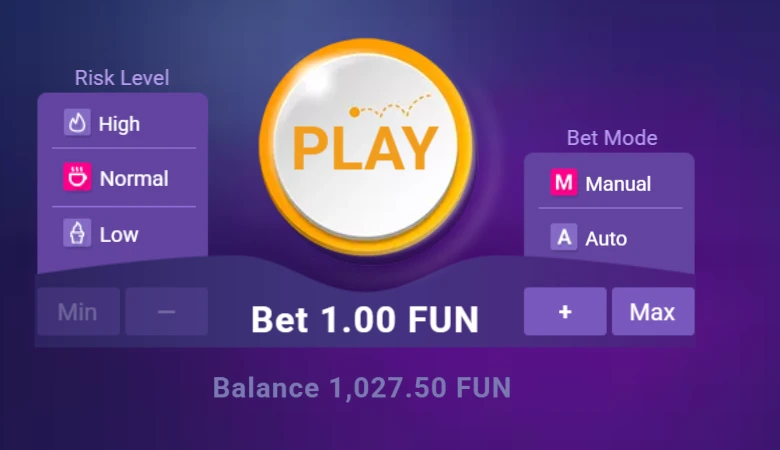
The demo interface gives you a small set of controls, and each one changes a different part of the game. Lines sets the number of rows of pegs the ball falls through, from 8 to 16. More rows mean more pockets at the bottom and a wider spread of possible outcomes. Risk Level offers Low, Normal and High, and it changes the multiplier printed on each pocket without changing where the ball is likely to land. The bet minus and plus buttons (with Min and Max shortcuts) set your stake per drop. Manual mode drops one ball per press of Play; Auto mode repeats drops, and in the version checked here Auto offers a bet count plus a Stop button only. Native loss-limit or profit-stop controls inside Auto were not verified in this version, so do not assume they exist.
Rows, risk and stake affect different parts of the calculation. Rows determine the pocket distribution; risk selects the payout map for those pockets; stake scales the returned amount. At a fixed pocket and table, doubling the stake doubles gross return and net change, subject to rounding. Budget duration therefore depends on all these choices and the realised outcomes, not stake alone.
One caution about versions: this article describes BGaming's Original Plinko as published on the provider's official demo and rules pages. Other studios ship their own Plinko games with different row ranges, different risk labels and different payout tables. Settings advice that assumes these exact multipliers does not transfer automatically. Before applying anything here to another version, check that version's own paytable; our overview of different Plinko versions explains why the numbers differ.
The exact 16-row payout table
At 16 rows there are 17 pockets, indexed 0 to 16 from one edge to the other. The ball's path is a binomial process with 16 rows and a 50/50 bounce at each peg, so the centre pocket (index 8) is the most likely landing spot and the two edges are the rarest. One specific edge pocket has a probability of 1 in 65,536; landing on either edge combined is 1 in 32,768. Crucially, this probability vector is identical across all three risk levels at 16 rows. Risk Level changes only the multipliers attached to the pockets, never the physics of the drop.
The table below lists every pocket with its multiplier under each risk level and its exact landing probability. Payout tables for row counts other than 16 are not verified for this article, so treat this as the 16-row reference only.
The exact centre, index 8, pays 0.5× on Low, 0.3× on Normal and 0.2× on High. Low’s neighbouring pockets 7 and 9 pay 1×. High’s five central pockets, 6 through 10, all pay 0.2×; pockets 5 and 11 pay 2×, then 4×, 9×, 26×, 130× and 1,000× as you move outwards. The same pocket can therefore produce very different net results under different tables.
| Pocket index | Low multiplier | Normal multiplier | High multiplier | Landing probability |
|---|---|---|---|---|
| 0 | 16× | 110× | 1000× | 0.0015259% |
| 1 | 9× | 41× | 130× | 0.0244141% |
| 2 | 2× | 10× | 26× | 0.1831055% |
| 3 | 1.4× | 5× | 9× | 0.8544922% |
| 4 | 1.4× | 3× | 4× | 2.7770996% |
| 5 | 1.2× | 1.5× | 2× | 6.6650391% |
| 6 | 1.1× | 1× | 0.2× | 12.2192383% |
| 7 | 1× | 0.5× | 0.2× | 17.4560547% |
| 8 | 0.5× | 0.3× | 0.2× | 19.6380615% |
| 9 | 1× | 0.5× | 0.2× | 17.4560547% |
| 10 | 1.1× | 1× | 0.2× | 12.2192383% |
| 11 | 1.2× | 1.5× | 2× | 6.6650391% |
| 12 | 1.4× | 3× | 4× | 2.7770996% |
| 13 | 1.4× | 5× | 9× | 0.8544922% |
| 14 | 2× | 10× | 26× | 0.1831055% |
| 15 | 9× | 41× | 130× | 0.0244141% |
| 16 | 16× | 110× | 1000× | 0.0015259% |
Game limits and model precision
The recorded demo configuration specifies a minimum stake of 1 FUN and a maximum of 100 FUN. The simulator stays within those bounds; the 64 FUN comparison cap is our chosen lower limit. It stops a percentage rule if the calculated amount falls below 1 FUN, rather than silently raising the stake.
Percentage stakes in this mathematical replay are rounded down to cents; gross returns are rounded to the nearest cent. That is an explicit modelling convention, not a claim that every native plus/minus step or payout-rounding rule has been reproduced. If your game cannot select a calculated amount, an adjusted rule is a different test. Even an integer such as 4, 8, 16 or 32 FUN is unavailable in the observed button sequence. Select demo-step mode to calculate an explicitly adjusted rule.
Variance vs RTP: why the risk levels feel so different
The theoretical return to player is nearly identical across the three profiles at 16 rows: about 98.999% on Low, 98.988% on Normal and 98.976% on High. If RTP were the only thing that mattered, the risk setting would be almost irrelevant. What actually separates them is variance, and the standard deviation figures make this concrete: roughly 0.33× the stake on Low, 1.47× on Normal and 6.57× on High. High risk swings about twenty times harder than Low per drop, for a theoretical return that is only a few hundredths of a percentage point lower.
The profit and loss probabilities tell the same story from another angle. On Low, about 45.4% of drops return more than the stake, 34.9% return exactly the stake, and only 19.6% return less. On High, just 21.0% of drops are profitable, there is no break-even pocket at all, and 79.0% of drops return less than you staked. High risk is a profile where most drops lose a little and the rare edge hits decide everything. Normal sits between the two but leans toward the High experience: 54.6% of its drops return less than the stake.
This is why 'RTP is the same, so risk does not matter' is wrong in practice. RTP is a long-run average over an enormous number of drops; variance is what you actually experience in a session of fifty or a hundred. With a small fixed budget, a High-risk session can exhaust the balance long before the long-run average has any chance to assert itself, while a Low-risk session at the same stake produces a much smoother balance curve. Neither profile changes the house edge in your favour; they change the shape of the ride.
It also means no setting creates an advantage. Claims seen in international forums — that changing seeds, tapping in bursts, or raising the stake after a run of low returns improves results — are not verified predictive advantages. Each drop is independent, and the binomial probabilities above do not remember previous outcomes. Our Plinko odds page covers the underlying mathematics in more depth, and the predictor page explains why prediction tools cannot beat these probabilities.

Partial returns: a loss is not the whole stake
The most common misunderstanding about Plinko settings is treating every non-winning drop as a full loss of the stake. It is not. Every pocket returns a multiple of the stake, so the net result of a drop is the return minus the stake. A 2 FUN stake landing on 0.5× returns 1 FUN, for a net result of −1 FUN, not −2. The same 2 FUN stake on a 9× pocket returns 18 FUN, a net of +16. Keeping gross return and net result separate is essential for judging any setting or staking plan honestly.
This matters most on High risk, where the 0.2× pockets dominate. Twenty losing High-risk drops at 1 FUN each, all landing on 0.2×, cost 16 FUN in total (20 staked, 4 returned), not 20 FUN and certainly not some larger figure. That is still a steady drain — four-fifths of everything staked on those drops is gone — but it is a different number from 'twenty losses equals twenty stakes', and confusing the two leads to badly wrong budget maths.
The same precision applies to staking systems. A capped Martingale running 1–2–4–8–16 has a total turnover of 31 FUN across those five drops. If every drop lands on 0.2×, the gross return is 6.2 FUN and the net result is −24.8 FUN, not −31. Resetting to 1 FUN for a sixth drop brings the six-drop turnover to 32 FUN with a net of −25.6 FUN at the same returns. An uncapped Martingale hits a different wall: after 1, 2, 4, 8, 16, 32 and 64, the next doubling stake of 128 exceeds a 64 FUN cap, so the sequence simply cannot continue. Systems that assume even-money wins, like the classic 1–3–2–6 cycle, also break down here: four consecutive wins at exactly 2× would net +12, but Plinko wins are not all 2×. On Low risk, 1.1× wins on the 1 and 3 stakes net only +0.4 combined, and a 0.5× result on the 2 stake loses 1, leaving the cycle at −0.6. Our Martingale guide works through these sequences drop by drop.
A worked setup for a fixed 100 FUN budget
Here is a concrete way to configure the demo for practice, using a fixed 100 FUN budget. FUN is virtual credit with no cash value; if you ever think about a real-money equivalent, treat any EUR figure as a purely hypothetical illustration, not something measured or recommended. Set Lines to 16 so the payout table above applies exactly. Then choose Risk Level based on what you want to practise: Low if you want long sessions and smooth balance movement, High if you want to experience how quickly variance can dominate a small budget, Normal for something in between.
With a flat 1 FUN stake, 100 completed drops produce 100 FUN of turnover. They do not necessarily lose 100 FUN: returned credits are added back after each result. At 16-row Low, the lowest multiplier is 0.5×, so a losing drop costs 0.5 FUN net. At High it is 0.2×, costing 0.8 FUN. Twenty such High losses cost 16 FUN. That arithmetic describes the exposure; it does not promise that the next drops will recover it.
For percentage staking, specify the fraction and rounding. Our simulator uses 0.5% of the current balance rounded down to the nearest 0.01 FUN, stopping below the demo’s 1 FUN minimum. It does not raise the calculated stake just to keep playing. You can compare the rule with fixed stakes on identical data in the simulator. Native game Auto controls are separate; do not assume the simulator’s cycle limits exist in the game.
One more budgeting point that trips people up: expected loss is a property of total turnover, not a line any individual session must follow, and drawdown is measured from an earlier balance peak, not from your starting amount. If your 100 FUN rises to 140 and then falls to 110, you are up 10 on the session but in a 30 FUN drawdown from the peak. Tracking both numbers keeps your expectations honest.

Match the settings to the game you actually opened
For readers in Italy, the settings advice above applies to the game itself, but the context around where you play matters separately. Remote gambling operators in Italy are authorised by ADM, and the reliable check is to verify the exact domain and legal entity against ADM's current official register. An ADM logo on a page, or a familiar game provider's name in the lobby, is not by itself proof that the specific operator you are on is licensed. No specific partner operator is verified or endorsed here, and this site makes no claims about operator availability, payment speeds or tax treatment.
Before copying a preset, compare the provider, row count and full payout table. A screenshot showing a 1,000× maximum is not enough to identify the game. Two products may share that headline while paying different amounts in the common pockets. The version identifier helps you decide whether these calculations apply.
Finally, a note on expectations shaped by social media. In Italian Reddit threads about scam advertisements, people ask whether slick advert videos and instant bank notification screenshots prove that withdrawals arrive. They do not: a video of a game and a payment promise are easy to fabricate, and it is important to distinguish the actual game from third-party apps that borrow its look and from the promises wrapped around it. That is not a claim that every Plinko product is fraudulent — it is a reminder that advertising material is not evidence of anything. Our Plinko apps page goes deeper into separating the game from the marketing around it.
Common questions
What is the best risk level for Plinko?
There is no objectively best level — the theoretical RTP is nearly identical (about 98.98–99.00% at 16 rows). Low risk suits small budgets and long sessions because most drops return at least half the stake. High risk suits players who accept that 79% of drops return less than staked in exchange for rare large multipliers. Choose based on the swings you can tolerate, not on expected return.
Does changing the number of rows change where the ball lands?
Rows change the number of pockets and the shape of the probability distribution — more rows mean a wider spread and rarer edge hits. At 16 rows, one specific edge pocket lands once in 65,536 drops on average. Risk Level, by contrast, changes only the multipliers, never the landing probabilities.
If the ball lands on 0.2×, do I lose my whole stake?
No. A 0.2× result returns one-fifth of the stake, so the net loss is 80% of it. A 1 FUN stake landing on 0.2× returns 0.2 FUN for a net result of −0.8 FUN. Twenty such drops cost 16 FUN in total, not 20.
Does raising my stake after a run of low returns improve my chances?
No predictive advantage from stake timing, seed changes or tapping patterns has been verified. Each drop is independent with fixed binomial probabilities. Raising the stake only increases the amount exposed to the same house edge.
Is the Plinko FUN demo the same as playing for EUR in Italy?
The FUN demo uses virtual credit with no cash value and is useful for practising settings. Real-money play in Italy should only happen with an operator whose exact domain and legal entity appear in ADM's official register. Any EUR budget discussion is hypothetical, not a measurement or recommendation.
Do these payout tables apply to every Plinko game?
No. These are the verified 16-row tables for BGaming's Original Plinko. Other providers use different row ranges and multipliers, and even the payout tables for other row counts in this game are not verified here. Always check the paytable of the specific version you are playing.