
What a Betting System Can and Cannot Change in Plinko
BGaming's original Plinko drops a ball through 16 rows of pins into 17 pockets. The landing position follows a Binomial(16, 0.5) distribution: the centre pocket (index 8) is the most likely at about 19.6% of drops, one specific edge pocket occurs once in 65,536 drops on average, and either edge combined once in 32,768. This probability vector is identical whether you play Low, Normal or High risk at 16 rows — only the multiplier table changes.
The theoretical return sits just under 99% on all three risk profiles: 98.999% on Low, 98.988% on Normal and 98.976% on High. That means the expected loss is a small fraction of total turnover, but it is an average across enormous numbers of drops — it is not a line any individual session must follow. A short session can land far above or far below it, especially on High risk, where the standard deviation of a single drop is about 6.57 times the stake.
Because the probabilities are fixed, no staking pattern creates an edge. What a system changes is variance management: how much you stake after wins and losses, how quickly the balance erodes during a bad run, and whether a losing streak forces you to stop. Choosing a system is really choosing a drawdown shape. The full probability tables for each risk level show why the same stake rule behaves so differently across profiles.
Partial returns: the number most players misread
Many Plinko pockets pay back less than the stake. On High risk, the five central pockets all return 0.2×. A 2 FUN stake landing at 0.5× returns 1 FUN — a net result of −1, not a break-even and not a full loss. A 2 FUN stake at 9× returns 18 FUN, a net of +16. Always separate the gross return (what the game credits) from the net result (gross minus stake).
This matters for every recovery-style system. Twenty consecutive High-risk drops at 0.2× with a flat 1 FUN stake from a 100 FUN balance lose 16 FUN, not 50 and not 20 — there is no such thing as a same-as-full-stake loss on those pockets, but the net still bleeds steadily. Systems that assume a win pays even money, like classic roulette Martingale logic, break down because Plinko wins pay anywhere from 1× to 1,000× and losses are usually partial.
Systems 1–2: Flat Stakes and Percentage Stakes
Start with a fixed stake as the comparison baseline; then decide which part of the rule you want to change. A percentage rule changes the initial stake as well as its later behaviour.
Flat staking means the same stake on every drop regardless of outcome: 1 FUN per drop, full stop. From a 500 FUN balance, the balance curve is a near-direct reflection of raw luck — nothing amplifies a bad run and nothing accelerates a good one. It is the only system where reading the result is effortless: net profit equals gross returns minus drops played.
Percentage staking uses 0.5% of the remaining balance, rounded down to the nearest 0.01 FUN. From 500 FUN the first stake is 2.50 FUN, not 1 FUN. If the calculated stake falls below 1 FUN, our replay stops; it does not impose a minimum bet and keep playing. Stakes shrink in a decline and grow after gains, but they can still exceed the 64 FUN cap after a sufficiently large rise.
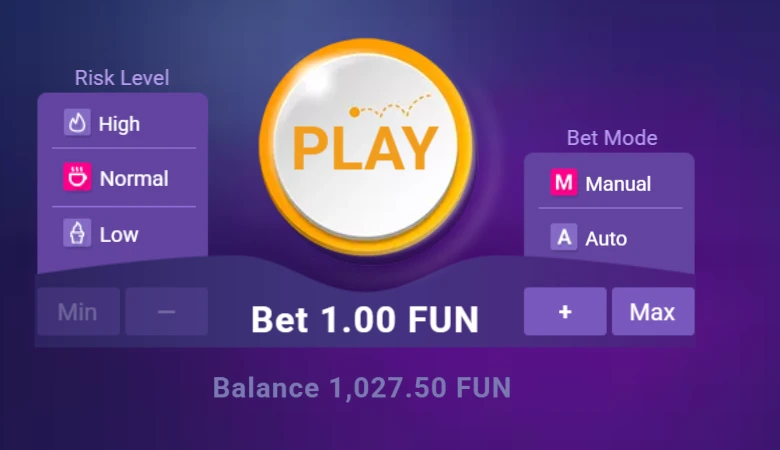
In Manual mode you control every drop; in Auto mode the verified controls let you set a number of bets plus a Stop button, so pre-commit to a drop count rather than chasing. Native loss/profit stop-cycle controls were not verified in this build, so treat your own limit as the real safety mechanism. Both systems are tested head-to-head against the others in the Plinko stake simulator.
- Set your base: flat = one fixed amount; percentage = 0.5% of the current balance.
- Place the same rule on every drop using the bet minus/plus controls or the Min/Max buttons.
- Round a percentage stake down to 0.01 FUN precision. Stop if it becomes smaller than 1 FUN or exceeds the cap.
- Stop at a pre-set balance limit, not at a feeling.
Game limits and model precision
The recorded demo configuration specifies a minimum stake of 1 FUN and a maximum of 100 FUN. The simulator stays within those bounds; the 64 FUN comparison cap is our chosen lower limit. It stops a percentage rule if the calculated amount falls below 1 FUN, rather than silently raising the stake.
Percentage stakes in this mathematical replay are rounded down to cents; gross returns are rounded to the nearest cent. That is an explicit modelling convention, not a claim that every native plus/minus step or payout-rounding rule has been reproduced. If your game cannot select a calculated amount, an adjusted rule is a different test. Even an integer such as 4, 8, 16 or 32 FUN is unavailable in the observed button sequence. Select demo-step mode to calculate an explicitly adjusted rule.
Systems 3–5: Martingale, Capped Martingale and D'Alembert
Loss progressions raise the stake after a losing drop. They exist to recover deficits quickly, and they all share the same structural weakness: a long enough losing run either exhausts the balance or hits the stake cap.
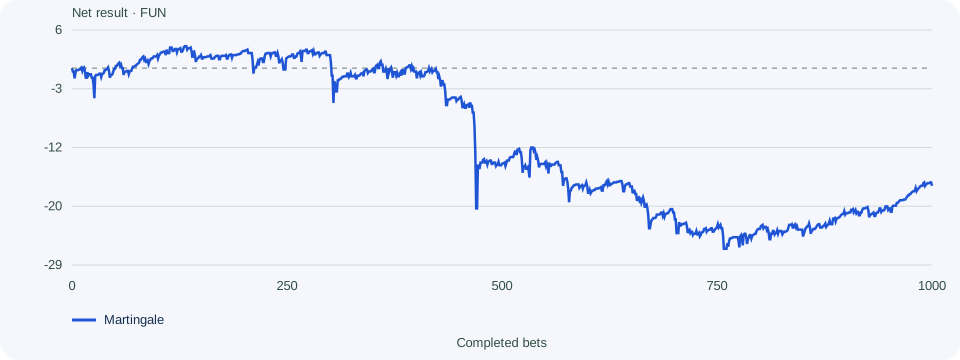
Martingale doubles after each net loss: 1, 2, 4, 8, 16, 32 and 64 FUN. All seven stakes are allowed by a 64 FUN cap, provided the balance covers them. Seven 0.2× returns produce 127 FUN turnover and −101.60 FUN net; the next required 128 FUN bet is blocked. Six losses alone total 63 FUN turnover and −50.40 FUN net, but still allow the seventh 64 FUN stake. A small positive multiplier can reset the ladder without recovering the whole chain. See the worked Martingale examples.
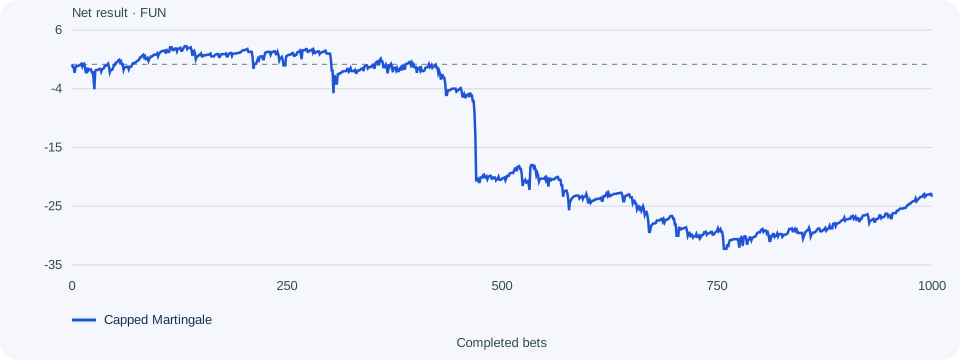
Capped Martingale limits the ladder — 1, 2, 4, 8, 16, resetting to the base after the fifth loss. The first five stakes total 31 FUN of turnover; at 0.2× each, gross returns are 6.2 FUN for a net of −24.8. The reset sixth drop at 1 FUN makes six drops and 32 FUN turnover, net −25.6. The cap converts catastrophic tail risk into frequent, bounded losses — survivable, but the expected value per drop is unchanged.
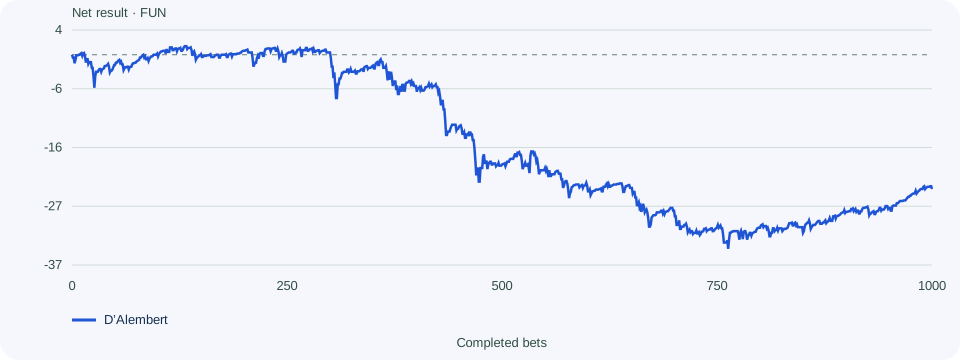
D’Alembert adds one base unit after a net loss and subtracts one after a net profit, down to the base. Break-even leaves the level unchanged. Its rise is linear rather than exponential, but a long enough imbalance between losses and wins still reaches a cap. In our Normal replay it stopped after 146 bets at the 64 FUN limit; slower growth is not immunity from a hard stop.
| System | Rule after loss | Rule after win | Worst-case stake (replay cap 64) | Main failure mode |
|---|---|---|---|---|
| Flat | No change | No change | 1 FUN | Balance exhaustion remains possible |
| Percentage 0.5% | Stake shrinks with balance | Stake grows with balance | 0.5% of balance | Slow recovery after drawdown |
| Martingale | Double | Reset to base | 64 FUN (cap blocks 128) | Cap or balance exhaustion |
| Capped Martingale | Double, max 5 steps | Reset to base | 16 FUN | Repeated bounded −24.8 style losses |
| D'Alembert | +1 unit | −1 unit (min base) | Grows 1 per loss | Slow grind during long red runs |

Systems 6–8: Fibonacci, Paroli and 1–3–2–6
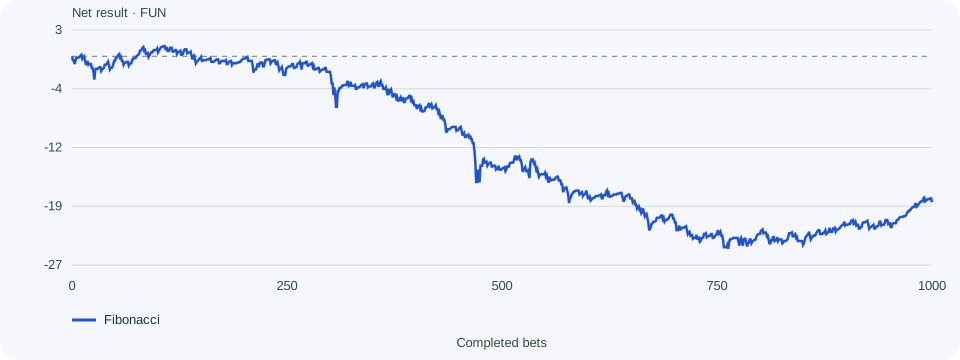
Fibonacci advances one position after a net loss and retreats two after a net profit: 1, 1, 2, 3, 5, 8… base units. Six 0.2× losses use 20 FUN turnover and lose 16 FUN net. Growth is slower initially than doubling, but eventually reaches 55 and then 89, beyond our cap. The Normal replay stopped after 46 bets. A step backwards is a rule change, not proof of financial recovery.
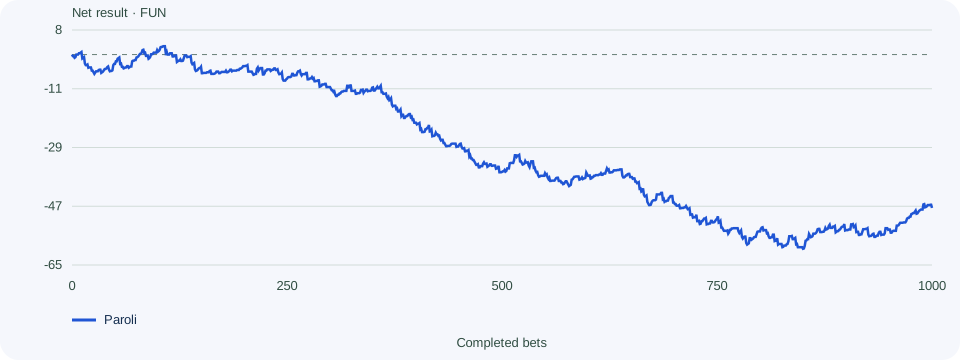
Paroli doubles after net profits through 1, 2 and 4 units, resetting after three profitable results or any loss. Break-even holds the level. Raised bets are not necessarily financed by previous profits: a 1 FUN bet at 1.1× earns only 0.10 FUN before the rule asks for a 2 FUN stake. On High the recorded replay completed at +43.6 FUN but had 187.6 FUN drawdown.
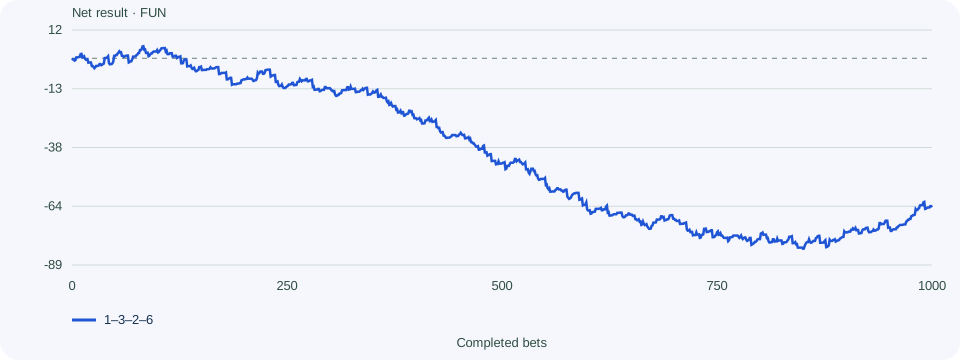
The 1–3–2–6 system stakes 1, then 3, then 2, then 6 units across four consecutive wins, resetting on any loss. The textbook claim — four wins net 12 units — only holds if every win pays exactly 2×. Plinko does not work that way. On Low risk, a 1.1× payout on the 1- and 3-unit stakes nets just 0.4 units, and if the third stake of 2 units lands at 0.5× it loses 1 unit, leaving the combined sequence at −0.6 despite two 'wins'. Partial multipliers quietly dismantle fixed-sequence maths.
Compare the actual curves, not a system stereotype
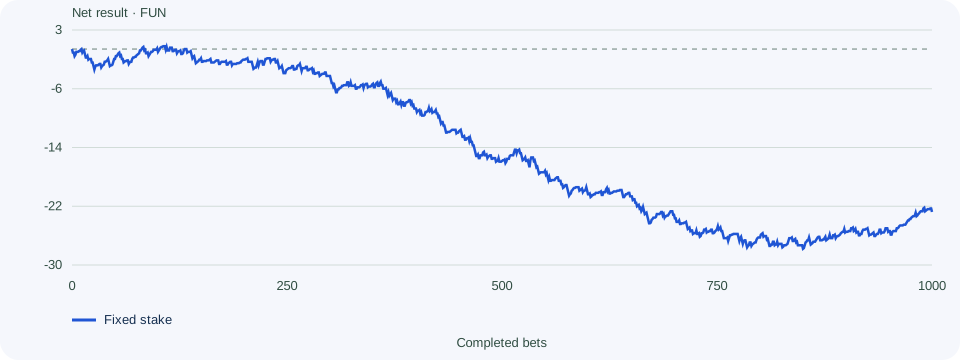
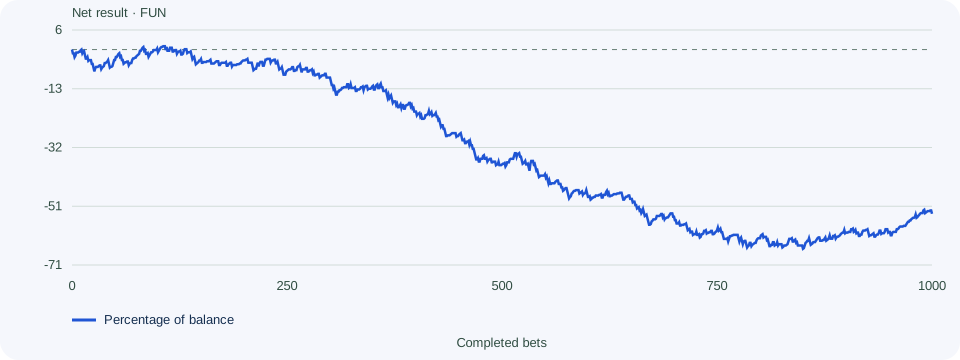
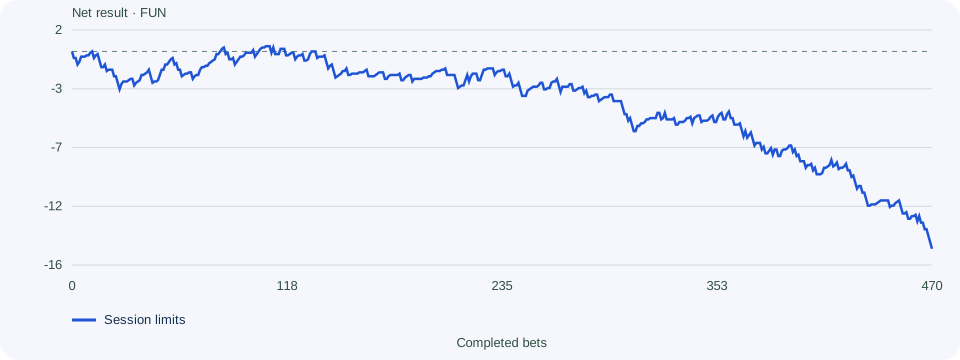
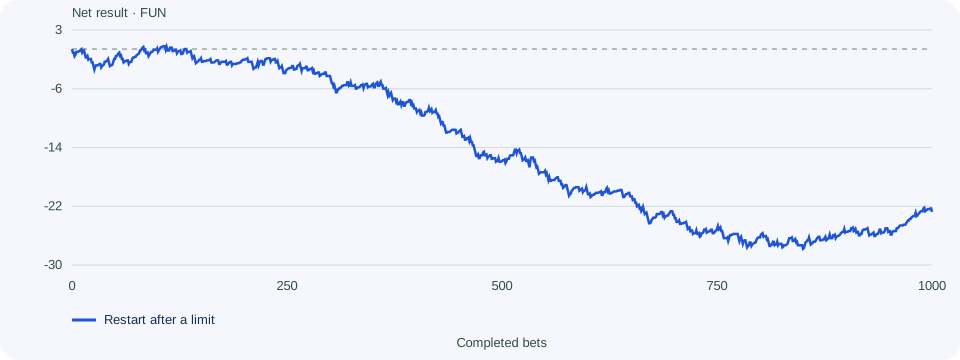
Win progressions raise stakes after profitable outcomes, while loss progressions raise them after negative ones. Neither guarantees a calmer balance. Compare the completed bets, turnover and drawdown in the charts below. The recorded study reports both positive replays and early cap stops without treating them as equivalent full-sample results.
Systems 9–10: Stop Limits and Restarting the Same Bank
System nine uses fixed 1 FUN stakes and stops when the cycle net reaches or crosses −15 FUN or +15 FUN. These are absolute amounts, not percentages. The last result is credited in full, so a large multiplier can take the net far beyond the target. In our High replay the profit threshold was crossed on drop 80, ending at +117.2 FUN.
System ten restarts after the same threshold with the remaining bank. It resets the cycle counter, not the money. At fixed stakes and without skipped drops, its full balance curve must equal the ordinary fixed-stake curve. The cycle labels help account for sessions but cannot turn a losing full history into a profitable one by erasing earlier losses.
Two measurement rules apply to every system on this page. First, drawdown is measured from the earlier peak, not from the starting balance — a balance that rises to 700 FUN and falls to 500 has a 200 FUN drawdown even though it 'only' returned to start. Second, gross return and net result must never be conflated: a 64 FUN stake at 0.2× 'returns' 12.8 FUN, which sounds like a win until you subtract the stake.
- Note the balance at the cycle start.
- Use the base stake on every drop for these two rules.
- At −15 or +15 FUN from the cycle start, stop or begin a new cycle according to the selected rule.
- Record the net result, then decide consciously whether to open the next cycle from the current balance.

Common 'Tricks', Forum Claims and a Sensible Setup
Questions that recur constantly — 'how to win at Plinko', 'is there a trick', 'what does Reddit say' — mostly reduce to three claims. First, that changing the seed or re-rolling the client seed improves outcomes. Second, that tapping or releasing drops in bursts influences the ball. Third, that raising the stake after a run of low returns is 'due' to pay off. None of these has a verified predictive advantage: each drop is independent, and the binomial distribution does not remember the previous ball.
Italian readers should also separate the game from the apps and adverts built around it. Threads in Italian scam-ad communities describe advert videos and instant bank-notification screenshots presented as proof of withdrawal. A video of gameplay and a payment notification prove nothing by themselves; the official BGaming game is one thing, third-party apps and their promises are another. Our Plinko apps guide and predictor-tool page go deeper, and no universal 'all Plinko is fraud' claim is made here either — the point is to verify, not to generalise.
For an Italian real-money account, game identity and operator identity are separate checks. Read the exact domain and legal entity against current official ADM information. The guide’s international FUN demo does not verify account eligibility, payments or a partner destination.
For a practical exercise, choose one risk in the simulator, keep the 500 FUN starting bank and compare rules without changing several inputs at once. Read the complete curve and stop reason. For the game interface, open the FUN demo and follow the stake instructions manually. Virtual results are not euro winnings.
These ten graphs use the cent-precision model. In the simulator you can compare it with the actual demo steps.
Compare 10 strategies
Replay: 500 FUN starting bank, 1 FUN base stake, 64 FUN cap. A system that stops early has not survived all 1,000 drops.
Fixed stake
Use the same stake for every drop. A loss does not change the next stake.
Percentage of balance
Before each drop calculate the chosen fraction of the remaining balance. At 500 FUN and 0.005, the first stake is 2.50 FUN. In the model, round down to a cent and stop below 1 FUN. Check that the actual game accepts the amount.
Martingale
Start at the base stake. Double after a net loss; reset after a net profit. Keep the level after break-even. Stop if the required stake exceeds the cap or balance.
Capped Martingale
Use at most 1, 2, 4, 8 and 16 base units. Reset after the fifth net loss or after any net profit. A break-even result keeps the level.
D’Alembert
Add one base unit after a net loss; subtract one after a net profit, never below the base stake. Break-even leaves the stake unchanged.
Fibonacci
Follow 1, 1, 2, 3, 5, 8… base units. A net loss moves forward one position; a net profit moves back two, no earlier than the start. Break-even keeps the position.
Paroli
Double after a net profit, up to three successive profitable results, then reset. A net loss resets immediately. Break-even keeps the level.
1–3–2–6
Use 1, 3, 2 and 6 base units after successive net profits. Reset after completing the sequence or after a net loss. Break-even does not advance it.
Session limits
Stake the base amount and compare the cycle net with both limits. Stop after the first result that reaches or crosses a threshold; we do not truncate that result to the threshold.
Restart after a limit
Stake the base amount. At a limit, begin a new cycle with the remaining balance. Do not refill the bank or erase losses. Continue on the next drop.
Common questions
Is there a strategy that actually beats Plinko?
No. The theoretical return is fixed at roughly 99% on all three risk levels, and every drop is independent. Strategies only reshape how wins and losses are distributed across your session — they cannot create a positive expectation.
Does Martingale work on Plinko?
It can finish a historical sequence in profit, but it does not guarantee recovery. In Plinko a small net win may reset the stake while the chain remains negative, and the next required stake may exceed the cap.
Which risk level suits a staking system best?
There is no universally best combination. At 16 rows the tables have similar theoretical RTP but very different return variability. Compare the same rule, starting bank and exposure on each table rather than assuming a lower risk label guarantees a better strategy result.
Is a 0.5× return a loss of half my stake?
Yes in net terms: a 2 FUN stake at 0.5× returns 1 FUN, a net of −1. It is not a full loss, but it is never a break-even. Always subtract the stake from the gross return.
Do seed changes or tap timing improve results?
There is no verified predictive advantage to changing seeds, tapping in bursts, or raising stakes after low returns. Each drop follows the same binomial distribution regardless of what happened before.
How can I test these systems without spending money?
Use the official FUN demo for the controls or this site’s simulator for repeatable calculations. Its stop and restart rules use configurable FUN amounts; the default thresholds are 15 FUN, not 15%.