
What a Plinko predictor can and cannot do
At 16 rows the verified model gives 17 possible pockets with binomial probabilities. The centre, pocket 8, has about 19.6% probability; one particular edge has 1 in 65,536. These are probabilities, not knowledge of the next result. A claim to name the next pocket needs evidence of information beyond past visible outcomes. We have not established any such access or tested a paid signal service.
What a simulation can legitimately tell you is a frequency range. Over 1,000 drops you should expect the centre pocket to appear close to 196 times, give or take normal sampling variation, and you should not be surprised by long stretches without an edge hit. That is a statement about aggregates, not about the next drop. Treating 'the centre is due' as a signal is the gambler's fallacy in a new outfit.
The practical consequence: any predictor worth the name is a testing tool, not a signal tool. It replays a rule against recorded or simulated drops and reports the net result. If a rule only works when you already know the outcomes, it is curve-fitted, and the honest way to expose that is an out-of-sample check, which is exactly how we structured our own grid below.
The maths every prediction claim must answer to
Before trusting any predictor, check it against the known distribution. At 16 rows the landing probabilities are fixed: index 8 sits at about 0.1964, the pockets beside it at about 0.1746 each, and the two edges combined at 1 in 32,768. A claim that a tool lifts your edge-hit rate above that baseline is a claim to beat the binomial distribution itself, and it needs evidence far stronger than a screenshot.
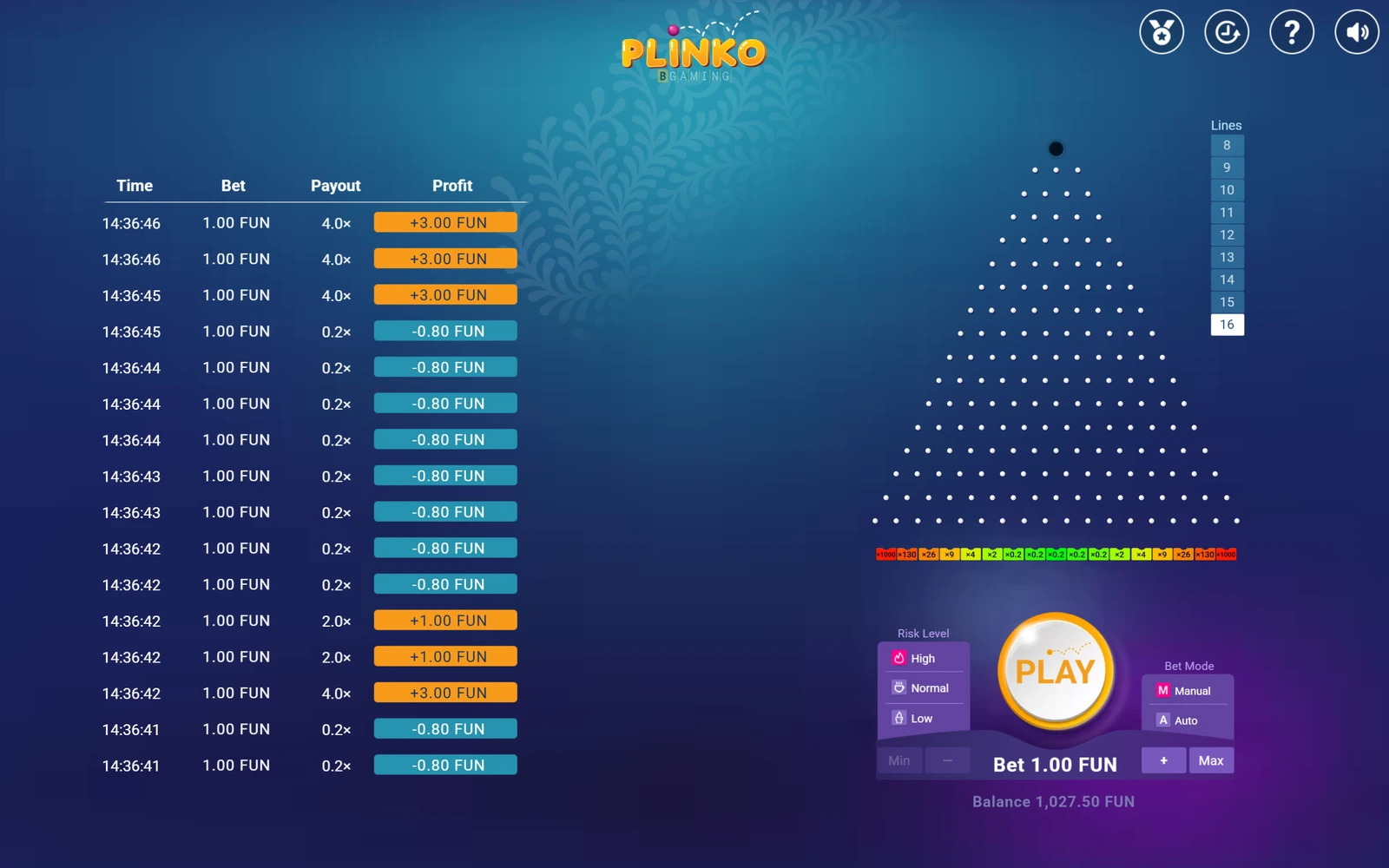
Risk changes payouts, not the landing vector at the same row count. Low has approximately 98.999% theoretical RTP and 45.4% profitable-drop probability; High has 98.976% theoretical RTP and 21.0% profitable-drop probability. The standard deviation of the return multiplier is about 0.33 on Low and 6.57 on High. Both High edge pockets combined pay 1,000× with probability about 0.00305%; one edge alone has half that probability.
Two consequences matter for prediction talk. First, the expected loss is a property of turnover, not a line any individual session must follow: short sessions will land far above or below it, and that variance is not a pattern to exploit. Second, a drawdown measured from an earlier peak is not the same thing as a minimum starting balance; a predictor that 'recovers losses' is describing variance, not repairing it.
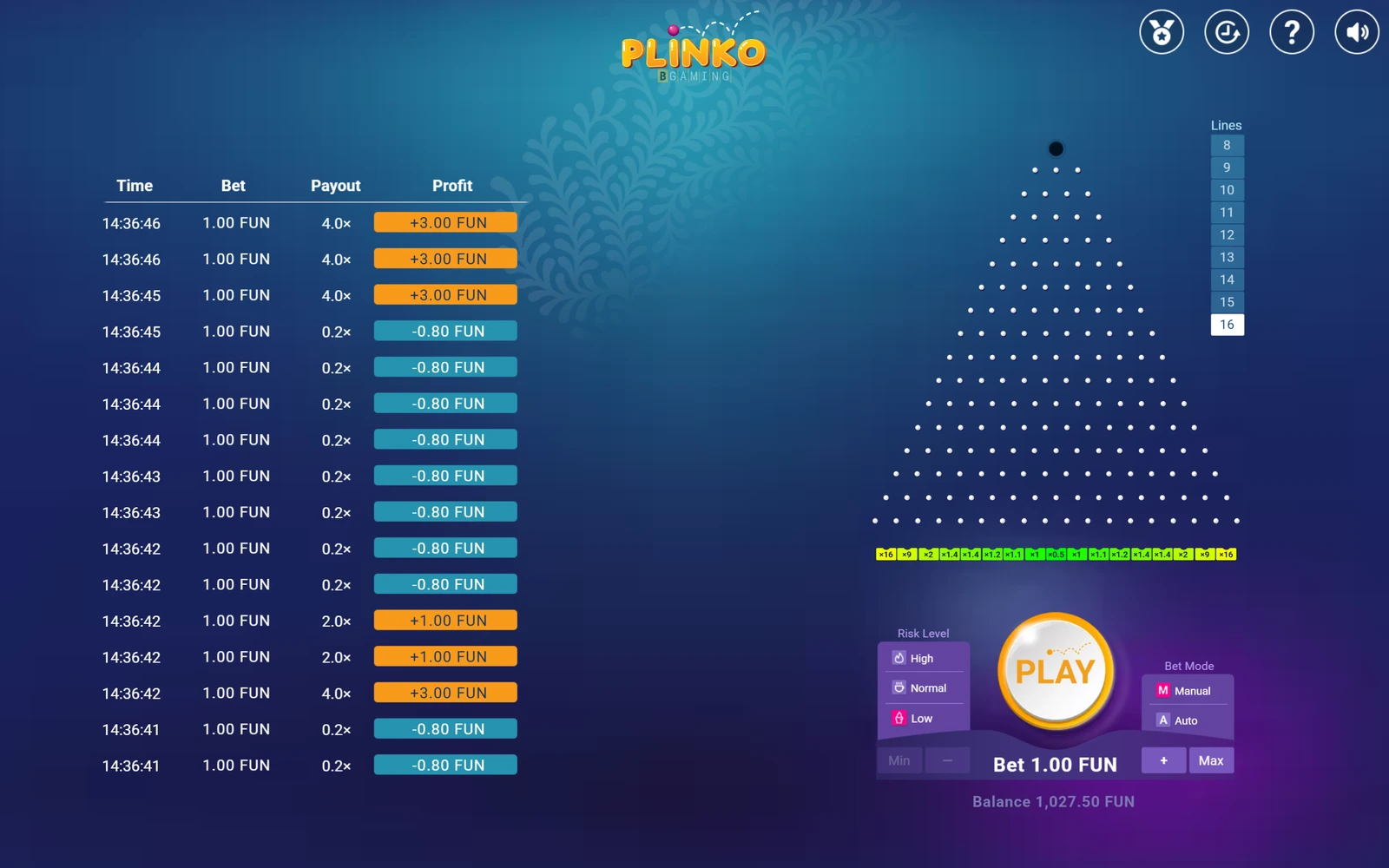
Partial returns also break most naive recovery logic. On High risk, many centre pockets pay 0.2x: a 2 FUN stake returns 0.4 FUN, a net loss of 1.6, not a full stake loss but not a win either. Twenty consecutive 0.2x drops at a flat 1 FUN stake lose 16 FUN from a 100 FUN bankroll, not 50 and not 20. Any predictor or staking sheet that treats a below-1x return as either a full loss or a full win is miscounting, and its projections are worthless.
| Profile | Theoretical RTP | Profit probability per drop | Std deviation (x stake) | Max multiplier |
|---|---|---|---|---|
| Low | 98.999% | 45.4% | 0.33 | 16x |
| Normal | 98.988% | 21.0% | 1.47 | 110x |
| High | 98.976% | 21.0% | 6.57 | 1000x |
The centre-count rule we actually tested
We made one pattern idea precise: raise the next stake when the exact centre has appeared no more than a chosen number of times in recent paid drops. The grid uses windows of 6, 10, 14, 18 or 24, thresholds 0–4, raised total stakes 4, 8, 16 or 32 FUN, and cooldowns 0, 4 or 9. That is 300 configurations per risk. We do not claim this is the most common rule among Italian players.
Every configuration was first searched across a full 1,000-drop historical file per risk. Then the configurations selected on the first 700 drops were re-checked on the last 300 drops with a fresh 500 FUN bankroll and an empty history, so the selection could not peek at the data it was judged on. This is the standard defence against overfitting: a rule that wins only on the drops used to invent it has predicted the past, not the game.
The full-history search found +60.7, +864.4 and +2,258 FUN on Low, Normal and High. Separately selected rules returned +37.6, −35.9 and +209.4 on the last 300 drops. These are retrospective checks, not a prospective trial or a promise that an apparent edge will persist. The study reports turnover, drawdown, exact parameters and selection conditions beside those totals.
You can reproduce the logic yourself. The Plinko simulator replays staking rules against the same payout tables, and the odds page lists the full probability vector so you can compute expected frequencies for any window length before trusting a claimed pattern.
Replaying staking systems without fooling yourself
A staking rule determines the amount exposed; a prediction would require evidence about the outcome. Keep those claims separate. Our comparison starts from 500 FUN with base 1 and cap 64. Only Stop limits and Restart use the configurable 15 FUN cycle thresholds. The other rules stop for their own cap or balance conditions, not because they inherit every tool setting.
A 64 FUN cap permits seven Martingale stakes from a 1 FUN base: 1, 2, 4, 8, 16, 32 and 64. Seven High 0.2× returns lose 101.6 FUN net on 127 FUN turnover, and the next 128 FUN stake is blocked. The five-loss reset variant instead uses 1, 2, 4, 8, 16, then 1. Six such losses total 32 FUN turnover and −25.6 FUN net.
Fibonacci stakes 1, 1, 2, 3, 5 and 8 total 20 FUN; six 0.2× returns lose 16 net. The 1–3–2–6 system earns its textbook 12 units only if all four outcomes return exactly 2×. Percentage staking rounds the chosen fraction down to a cent and stops below 1 FUN. Each rule changes exposure; none of these arithmetic examples forecasts the next pocket.
A stake rule can change both a particular session’s final result and its path. What it does not change is the underlying expected return per unit staked under the same independent-outcome model. Some historical replays here finish positive; that is different from establishing a positive expected-value strategy. Compare the ten rules before interpreting a single fitted curve.
Predictor APKs and forum claims: what holds up
An APK promising live signals needs a verified publisher, a clear explanation of what it accesses and evidence collected before the outcomes. We have not audited such an APK. A download label and selected winning screenshots do not establish that it knows future server results. Our simulator and official FUN demo work in a browser without an APK installation.
We read two Italian threads on r/Italianscamads where people asked whether advert videos and instant bank notification screenshots prove a withdrawal worked. They do not: a video shows an interface, and a notification screenshot shows an image. It is essential to distinguish the actual game from a lookalike app and from the promises wrapped around it. This was not a representative poll, we verified no withdrawal, and we do not claim all Plinko-branded products are fraud; the point is narrower, that the 'proof' offered in these ads proves nothing.
Claims about tapping bursts, changing seeds or raising stakes after losses should be written as testable rules before new data is collected. Our study tests stake replays, not timing interventions or seed manipulation. Nothing in its results demonstrates that those actions change the verified pocket probabilities. A story about a lucky sequence is a starting question, not a controlled comparison.
To inspect the actual game, open the FUN demo and compare its controls with the version guide. Do not transfer a result to an unidentified app simply because it also uses a Plinko ball animation.
Italy-specific context and what to do in the actual game
For an Italian player, game identity and account identity remain separate. Check the exact operator domain and entity using current official ADM information before making any account decision. This site has not verified a funded Italian account, payment speed or a partner destination. The simulator is a virtual-credit tool.
Our testing used the international official FUN demo, not an Italian operator account, so nothing here depended on location, deposits or withdrawals. FUN is virtual credit only; it is not EUR and has no cash value. If you translate any example into a euro budget, treat it as a hypothetical illustration, not a measured outcome.
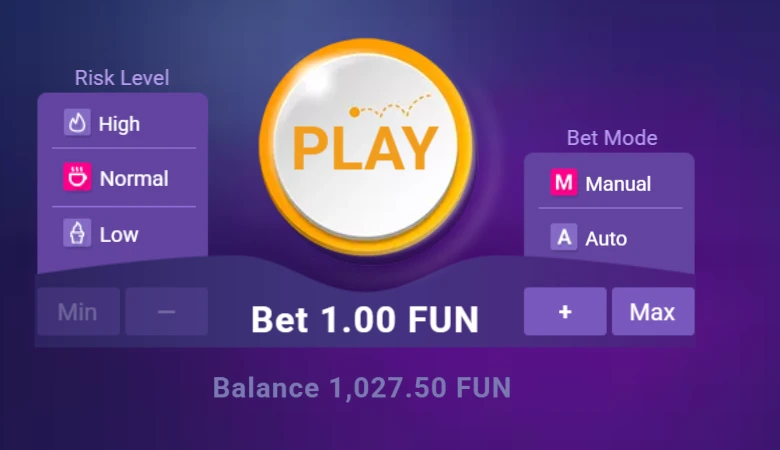
In the real interface the controls are simple and verified: Lines from 8 to 16, Risk Level Low, Normal or High, Bet adjustment with minus and plus plus Min and Max shortcuts, Manual or Auto mode, and the Play button. In Auto we observed a bet count and a Stop control; native loss or profit cycle limits within Auto were not verified. If you want to experiment with a predictor-style rule, the sane procedure is: set Lines to 16 so the published probability table applies, pick a risk profile whose volatility you actually tolerate, set a flat stake sized so a realistic losing run is affordable, and track gross returns and net results separately in a file of your own.
For a useful next experiment, write the rule, risk, stake cap and stopping condition before collecting a new sequence. Keep every completed result, including losses and failed candidates. That makes a later comparison interpretable. If the rule changes after you see the results, label the new exercise as another historical search rather than continuing to call it an untouched test.
- Open the official FUN demo in your browser; install nothing.
- Set Lines to 16 and choose a Risk Level whose volatility you accept.
- Set a flat stake sized so 20 consecutive low returns are affordable.
- Record each drop's gross return and compute the net result separately.
- Test any rule on recorded history first, then on fresh drops it has never seen.
- Stop when your pre-set session limit is reached, in either direction.
Settings selected on the entire recorded history · Observed demo steps
This search uses selectable raised stakes of 5, 10, 20 or 30 FUN. The amounts below can be selected with the observed buttons.
We compared 300 parameter combinations per risk. Choosing the best across all 1,000 drops uses the whole history to select settings: this is retrospective fitting. Each replayed bet itself reads only earlier pockets.
| Risk | Previous paid drops to count | Maximum centre hits | Triggered TOTAL stake ·FUN | Base-stake drops after a raised bet | Net result | Total staked | Largest fall from a peak |
|---|---|---|---|---|---|---|---|
| Low | 18 | 3 | 30 FUN | 4 | +55.3 FUN | 4,277 FUN | 101.6 FUN |
| Normal | 6 | 1 | 30 FUN | 9 | +807.8 FUN | 3,465 FUN | 354.4 FUN |
| High | 6 | 3 | 30 FUN | 0 | +2,116.4 FUN | 29,391 FUN | 4,083 FUN |
To follow the rule: stake 1 FUN while waiting; count only the exact centre pocket, index 8, in the stated number of previous paid drops. If the count is at most the threshold, the next total stake rises to the table amount. Return to the base stake for the listed cooldown. There are no free observation drops and the next pocket is unknown.
Open these settings: Low Open these settings: Normal Open these settings: HighCommon questions
Can a Plinko predictor tell me the next pocket?
No. Each drop is an independent Binomial(16, 0.5) event at 16 rows; the centre pocket is always about 19.6% likely and each edge about 1 in 65,536, regardless of previous results. A legitimate predictor only estimates frequency ranges over many drops or replays staking rules against recorded outcomes.
Does counting recent centre hits improve my odds?
There is no mechanism by which it could, because drops are independent. We tested a 300-configuration grid of centre-count rules with lookbacks from 6 to 24 drops; any in-sample edge a rule shows must be re-checked on fresh data, where independence says it should shrink to zero.
Are Plinko predictor APKs safe to install?
We have not audited a predictor APK and cannot certify its safety or claims. A next-pocket signal needs evidence beyond selected wins. Our browser simulator requires no such installation.
Does raising my stake after low returns recover losses?
It may improve or worsen a particular recorded replay, but it does not change the next pocket’s probability. A 1 FUN Martingale with a 64 FUN cap allows seven stakes; seven 0.2× returns lose 101.60 FUN before 128 FUN is blocked.
Is a 0.2x return the same as losing my whole stake?
No. A 1 FUN stake at 0.2x returns 0.2 FUN, a net loss of 0.8. Twenty such drops lose 16 FUN, not 20. Any predictor or staking sheet that counts partial returns as full losses is miscounting.
How do I know a Plinko site is licensed in Italy?
Check the exact domain and legal entity against the current official ADM register. A game provider's name or an advert is not proof the operator itself is authorised, and we have not verified any specific partner.