
Why Classic Martingale Logic Breaks in Plinko
In an even-money example, losing stakes of 1 and 2 costs 3 units. A subsequent winning stake of 4 at 2× returns 8 units and earns 4 net, leaving the whole chain at +1. The total turnover was 7, but only the first 3 units were lost before the winning bet. Confusing turnover with losses makes even this simple example wrong.
Plinko does not work like that. On the 16-row board, the ball lands in one of 17 pockets, and most of those pockets pay less than your stake. On Low risk the central pocket pays 0.5x. On High risk the five central pockets pay 0.2x. A ball landing in the middle is not a win in Martingale terms at all: it is a partial loss. Stake 2 FUN at 0.5x and you receive 1 FUN back, a net result of -1. The system would call that a loss and double again, which is correct, but the danger is the pockets that pay slightly more than 1x, such as 1.1x or 1.4x on Low risk. Those return a small profit on the current stake but nowhere near enough to recover a chain of earlier losses.
Consider four Low-risk centre results at 0.5× with stakes 1, 2, 4 and 8 FUN. Turnover is 15 FUN, returned credits 7.5 and net loss 7.5. The next 16 FUN stake lands at 1.4×: return 22.4, net gain 6.4. The chain remains −1.1 FUN despite that profitable final drop. This is a valid same-table example; mixing full-stake losses or High payouts into a Low recovery calculation would misdescribe the game.
This is the core point of the whole page: in Plinko, a losing drop does not usually cost you the entire stake, and a winning drop does not usually double it. Any staking system imported from roulette needs to be rebuilt around partial returns, or it will mislead you from the first chain.

Partial Returns: Reading Net Results Correctly
Before touching any ladder, get the vocabulary right. The gross return is what the game credits back to your balance after a drop. The net result is the gross return minus the stake. A 2 FUN stake at 0.5x gives a gross return of 1 FUN and a net result of -1 FUN. A 2 FUN stake at 9x gives a gross return of 18 FUN and a net result of +16 FUN. Martingale decisions should always be driven by the net figure and by your cumulative position across the chain, never by whether the drop looked like a win.
The published probabilities for the 16-row board make the problem concrete. The landing positions follow a binomial distribution: the centre pocket is the most likely single outcome at roughly 19.6% of drops, and the two edge pockets combined occur about once in 32,768 drops. The same probability vector applies at every risk level; only the multipliers change.
On Low risk, the probability of finishing a single drop in profit is about 45.4%, with roughly 35% of drops returning exactly the stake and about 19.6% returning less. On High risk the picture inverts: about 79% of drops return less than the stake, because the five central pockets all pay 0.2x. The theoretical return to player sits close to 99% on all three risk levels, but that is a long-run average across every pocket, not a promise about any short chain of drops.
Two consequences follow. First, on High risk a Martingale chain is almost always a chain of partial losses, because four drops out of five return 0.2x. Second, the 'recovery win' the system waits for must come from the outer pockets, which is exactly where the ball rarely lands. The expected loss per unit of turnover is fixed by the game's maths; no staking pattern changes it. What staking patterns change is the shape of your balance curve: how fast you lose, how spiky the ride is, and where the hard stop hits.
| Risk level | Drops in profit | Drops at exactly 1x | Drops below 1x | Central pocket pays |
|---|---|---|---|---|
| Low | ~45.4% | ~34.9% | ~19.6% | 0.5x |
| Normal | ~21.0% | ~24.4% | ~54.6% | 0.3x |
| High | ~21.0% | 0% | ~79.0% | 0.2x |
Concrete Ladders: Uncapped, Capped and Reset Variants
With a 1 FUN base and 64 FUN cap, seven stakes are allowed: 1, 2, 4, 8, 16, 32 and 64. Their turnover totals 127 FUN. If all seven return 0.2×, returned credits total 25.4 and net loss is 101.6 FUN. The next 128 FUN stake exceeds the cap. After only six such losses, turnover is 63 and net loss 50.4, but the 64 FUN seventh stake is still allowed if the bank can cover it.
The capped variant used in our simulator is a five-step ladder: 1, 2, 4, 8, 16, then reset to 1 after the fifth loss. The first five stakes total 31 FUN of turnover. At 0.2x on each, the gross return is 6.2 FUN and the net is -24.8. The sixth stake is 1 again, so after six drops the turnover is 32 FUN and the cumulative net in that all-0.2x path is -25.6. The cap does not rescue the chain; it only decides how much one bad chain is allowed to cost before you accept the loss and start over.
Other ladders soften the growth. D'Alembert adds one unit after a loss and removes one after a win, never going below the base stake, so a six-loss run costs 1+2+3+4+5+6 = 21 FUN of turnover instead of 63. Fibonacci steps up one position after a loss and back two after a win: 1, 1, 2, 3, 5, 8 totals 20 FUN across six losses, and at 0.2x each the net is -16. Paroli inverts the idea, doubling after wins (1, 2, 4) and resetting after the third win or any loss, which caps the damage of losing streaks but gives up the recovery fantasy entirely.
The 1-3-2-6 system deserves a warning of its own, because it is usually explained with even-money examples. If all four steps win at exactly 2x, the net is +12 units. But Plinko wins are not exactly 2x. On Low risk, if the 1 and 3 stakes land at 1.1x and the 2 stake lands at 0.5x, the combined net of those three drops is -0.6 units even though two of them were 'wins'. The system's advertised outcome assumes a payout this game does not reliably offer.
One more correction to a common misconception: a losing drop is not the same as losing the whole stake. Twenty High-risk drops at 1 FUN each, all landing at 0.2x, cost 16 FUN from a 100 FUN balance, not 20 and certainly not 50. Partial returns cushion losing streaks slightly, which is exactly why naive Martingale arithmetic, done as if losses were total, always overstates both the danger and the recovery.
| System | Six-loss stake sequence | Turnover | Net if all drops pay 0.2x |
|---|---|---|---|
| Martingale (uncapped) | 1-2-4-8-16-32 | 63 FUN | -50.4 FUN |
| Capped Martingale (reset after 5) | 1-2-4-8-16-1 | 32 FUN | -25.6 FUN |
| D'Alembert (+1 per loss) | 1-2-3-4-5-6 | 21 FUN | -16.8 FUN |
| Fibonacci | 1-1-2-3-5-8 | 20 FUN | -16 FUN |

Running a Ladder with the Ordinary Game Controls
The official BGaming Plinko demo gives you a small set of controls: Lines from 8 to 16, Risk Level at Low, Normal or High, a Bet field with minus and plus buttons plus a Max shortcut, Manual and Auto modes, and the Play button. Everything in this guide uses 16 lines, because that is the configuration for which the full payout table and probabilities are published.
In Manual mode you run a ladder by hand: set the stake with the plus button before each drop according to your system's rule, press Play, record the result, adjust. This is slow but it forces you to see every net result, which is healthy when testing a progression. In Auto mode you set a number of drops and a stop condition; the stake, however, stays fixed for the whole auto run in the verified controls, so Auto cannot execute a Martingale progression for you. Native cycle loss or profit limits inside Auto were not verified in this demo, so do not rely on them existing.
Practical setup for a capped-Martingale test: decide the base stake (1 FUN), the cap (64 FUN, or a five-step reset at 16), the risk level, and a hard session limit before the first drop. A workable session rule is a stop at -15 or +15 FUN from the starting balance of the cycle, restarting from the same bank only after the limit is hit and recorded. Write the rules down before playing, because the entire failure mode of progression systems is improvising mid-chain: skipping a double 'just this once' or extending past the cap because the next drop feels due.
If you want to test ladders without clicking through hundreds of manual drops, our simulator at the Plinko stake-system simulator runs flat, percentage, Martingale, capped Martingale, D'Alembert, Fibonacci, Paroli and 1-3-2-6 staking against the published 16-row payout tables, with configurable caps and cycle limits. It reports gross returns and net results separately, which is the distinction this whole page is about. For the underlying numbers, see the Plinko odds breakdown and the guide to lines and risk settings.
- Open the official FUN demo and set Lines to 16 and your chosen Risk Level.
- Set the base stake with the minus/plus buttons, for example 1 FUN.
- Define the ladder rule, the cap and the session stop before the first drop.
- Play in Manual mode, adjusting the stake after each drop according to the rule.
- Record gross return and net result for every drop, plus the running chain total.
- Stop at the cap or session limit, log the chain as closed, and only then decide whether to start a new cycle.
Bankroll Sizing and a Hypothetical EUR Example
FUN has no cash value. For a separate hypothetical euro illustration, a €0.10 base with a €6.40 cap permits €0.10, €0.20, €0.40, €0.80, €1.60, €3.20 and €6.40. Seven stakes total €12.70 turnover. At 0.2× each, the net loss is €10.16, and the next €12.80 bet is blocked. This is arithmetic, not a tested euro session, an affordable budget recommendation or an operator limit.
Percentage staking uses a fraction of the remaining bank, rounded down to 0.01 FUN precision. It shrinks stakes in a decline, but can still hit a maximum-stake cap after sufficient gains. Our 0.5% rule starts at 2.50 FUN from 500 FUN, so it does not have the same turnover as a 1 FUN fixed rule. Compare exposure as well as the final result.
Whichever system you test, two accounting rules keep you honest. First, measure drawdown from your earlier balance peak, not from some minimum starting bank you have decided to grant yourself after the fact. Second, treat the expected loss per unit of turnover as a property of the game, not a line that any individual session must follow: short sessions deviate wildly in both directions, which is precisely what makes progressions feel like they work right up until they do not.
For readers in Italy: the demo on this site is the international official FUN version from the game provider, not an Italian operator account, and no funded operator availability has been verified here. If you ever play for real money, check that the exact domain and legal entity appear in the official ADM register; a logo or a provider name on a page is not proof of a licence. Nothing on this page is tax advice or a claim about payment speed.

What Martingale Can and Cannot Do in Plinko
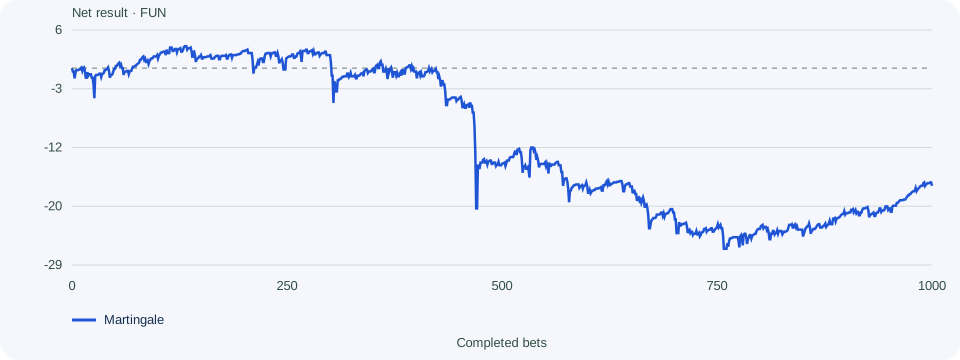
Martingale changes the size and timing of exposure. In our Low replay it completed 1,000 bets at −17.2 FUN; in Normal it stopped at the cap after 56 bets at −71 FUN. In High it stopped after 72 bets at +170.2 FUN. A cap can interrupt a profitable history too, so the stop reason and completed count belong beside the result.
What it cannot do: change the expectation. Every drop is independent, the binomial distribution does not remember your chain, and the mean return multiplier stays just under 1x regardless of stake size. Doubling after losses concentrates your losses into rare large events; it does not reduce them. The edge pockets that would actually rescue a deep chain, 16x on Low or 1000x on High, land about once in 32,768 drops combined, so 'waiting for the big one' is not a plan with a timeline.
Claims you may have seen in forums, that changing seeds, tapping in bursts, or raising the stake after low returns creates a predictive advantage, have not been tested as predictive advantages and contradict how the published probabilities work. Likewise, videos showing instant bank notifications do not prove a withdrawal system works; the game, the app wrapping it and the payment promises behind it are three separate things.
The useful test is whether the rule survives its stated limits and what it costs along the way. Run it in the simulator, inspect net results rather than payout labels, and compare it with a fixed stake on the same recorded pockets. The completed study includes both gains and early stops. A historical success is not a forecast of the next chain.
Common questions
Does Martingale work on Plinko?
Not in the classic sense. Martingale relies on wins paying double the stake, but most Plinko pockets return less than the stake. A 1.1x or 1.4x 'win' after a losing chain does not recover the earlier losses, so the system's core promise fails even though individual drops can be profitable.
Is a losing Plinko drop the same as losing the whole stake?
No. Most pockets return part of the stake: 0.5x in the centre on Low risk, 0.2x across the centre on High risk. Twenty High-risk drops at 1 FUN each, all at 0.2x, cost 16 FUN in total, not 20. Always count net results, not stakes.
What is a sensible cap for a Plinko Martingale chain?
Our comparison cap is 64 FUN with a 1 FUN base; it allows seven stakes before blocking 128 FUN. Seven High-risk 0.2× losses produce −101.60 FUN net. The capped-reset variant instead returns to the base after five losses. Neither setting is a universally safe budget.
Can Auto mode run a Martingale progression for me?
No. In the verified controls of the official demo, Auto runs a fixed stake for a chosen number of drops with a stop option. Doubling between drops requires Manual mode, where you adjust the Bet field yourself before each Play.
Which risk level suits a Martingale test best?
Low risk is the least hostile: about 45% of drops finish in profit and only ~19.6% return less than the stake. On High risk about 79% of drops pay 0.2x, so chains are almost entirely partial losses and recovery depends on rare outer pockets.
Does raising the stake after low returns improve my chances?
No. Each drop is independent and follows the same binomial probabilities regardless of previous results or stake size. Raising the stake changes how much you win or lose on the next drop, never where the ball is more likely to land.