
What the simulator actually does
The simulator takes a sequence of settled Plinko drops and applies a staking rule to them one at a time, exactly as if you had pressed Play that many times in the demo. Each drop has a stake, a multiplier and a payout. The tool tracks three things after every ball: the gross return (stake multiplied by the multiplier), the net result (gross return minus stake), and the running bank.
The default comparison uses a 500 FUN starting bank, 1 FUN base and 64 FUN cap. These are study settings, not a recommended real-money budget. The simulator stops before a required stake exceeds the bank or cap. It never clips an unaffordable stake down, because that would silently change the selected rule.
Recorded data contains 1,000 actual pockets per risk. Generated practice uses a reproducible numeric seed and the binomial probabilities, with up to 10,000 drops. The two sources answer different questions: recorded data describes one observed history; generated data explores the stated model. Neither is a prediction or a new live game session. Keep the source label beside any result you save.
Staking rules you can replay
Fixed staking repeats the base. Percentage staking uses the chosen fraction of the remaining bank, rounded down to 0.01 FUN precision. At the default 0.5%, the first stake from 500 FUN is 2.50 FUN. A calculated stake below 1 FUN stops the replay instead of being rounded up.
Martingale doubles the stake after every loss and resets to the base after a win. The capped variant runs 1–2–4–8–16 and resets after the fifth consecutive loss instead of doubling further. D'Alembert adds one unit after a loss and removes one after a win, never going below the base stake. Fibonacci steps one position forward in the sequence after a loss and two back after a win. Paroli runs 1–2–4 and resets after the third consecutive win or any loss. The 1–3–2–6 cycle advances on wins and resets on any loss.
Only the Stop limits and Restart rules use the configurable cycle thresholds, initially 15 FUN in either direction. Stop limits end the run; Restart keeps the remaining bank and opens a new fixed-stake cycle. Other rules do not inherit those thresholds. Across all progressions, an exact break-even result holds the current level; this is not a separate break-even stopping system.
Worked examples of the arithmetic
Partial returns are the part most players get wrong, so the simulator shows them explicitly. A 2 FUN stake landing on 0.5× returns 1 FUN gross, a net result of −1, not a full loss of 2. The same 2 FUN on 9× returns 18 gross, net +16.
Under capped Martingale, the first five stakes total 31 FUN of turnover. If all five land on 0.2×, gross return is 6.2 FUN and the net is −24.8; the sixth stake resets to 1, making six drops with 32 turnover and a net of −25.6. Under uncapped Martingale the sequence runs 1, 2, 4, 8, 16, 32, 64; the next stake of 128 exceeds the 64 cap, so the rule stops there. Six stakes at 0.2× each mean 63 turnover and a net of −50.4.
Fibonacci stakes of 1+1+2+3+5+8 total 20 turnover; at 0.2× each the net is −16. The 1–3–2–6 cycle only nets +12 if all four wins pay exactly 2×, which Plinko pockets do not guarantee: on Low risk, 1.1× on the 1 and 3 stakes nets just +0.4, and if the third stake of 2 lands on 0.5× it loses 1, leaving the cycle at −0.6. And twenty High-risk drops at a flat 1 FUN all landing on 0.2× lose 16 FUN from a 100 bank, not 50, because a 0.2× return is a partial loss, not a full one.
Game limits and model precision
The recorded demo configuration specifies a minimum stake of 1 FUN and a maximum of 100 FUN. The simulator stays within those bounds; the 64 FUN comparison cap is our chosen lower limit. It stops a percentage rule if the calculated amount falls below 1 FUN, rather than silently raising the stake.
Percentage stakes in this mathematical replay are rounded down to cents; gross returns are rounded to the nearest cent. That is an explicit modelling convention, not a claim that every native plus/minus step or payout-rounding rule has been reproduced. If your game cannot select a calculated amount, an adjusted rule is a different test. Even an integer such as 4, 8, 16 or 32 FUN is unavailable in the observed button sequence. Select demo-step mode to calculate an explicitly adjusted rule.
Run a comparison with the available controls
Select Recorded drops to use this study’s 1,000 pockets at the chosen risk, or Generated practice for a reproducible mathematical sample. The recorded mode accepts a prefix from 1 to 1,000 drops. It does not upload a custom sequence. Choose the rule, then check the starting bank, base and cap before calculating. Rule-specific controls appear only where they apply.
To compare rules, keep risk, source, seed or recorded prefix, and starting bank unchanged. Remember that percentage staking can begin above the fixed base amount, so inspect total turnover too. The result table includes the first 25 placed bets for readability; the CSV contains every placed bet, including later rows.
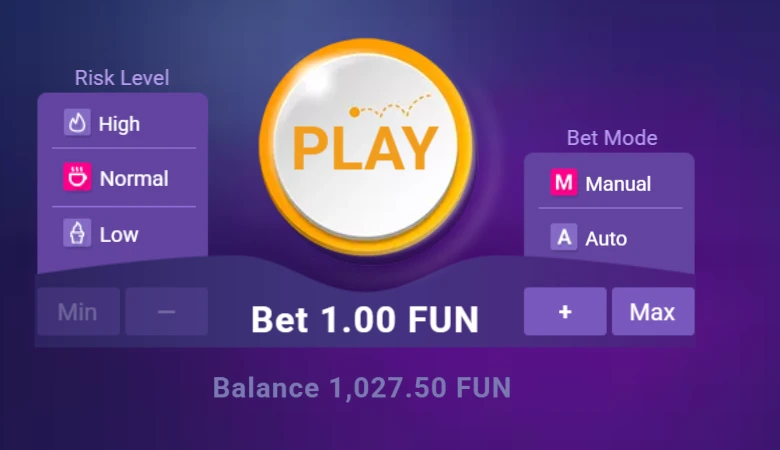
Use Copy settings to create a reproducible page address. The link preserves inputs, not a prediction or a live game state. To practise the same stake instruction by hand, use the official FUN demo in Manual mode. Check each settled net result before changing the next stake. The game’s native Auto interface is separate from this simulator.
- Choose recorded pockets or generated practice.
- Choose risk, rule and starting bank.
- Check the rule-specific fields and calculate.
- Read net, drawdown, turnover, completed bets and stop reason.
- Change one rule at a time on the same sample.
- Download the bet CSV or copy a settings link.

Reading the bank graph without fooling yourself
The graph shows net change from the starting bank, not the absolute balance. Zero is break-even. A value of +50 FUN means a 550 FUN balance if the start was 500. Drawdown measures the fall from an earlier peak: a bank rising to 700 and falling to 550 has 150 FUN drawdown. The bet table and CSV show the stakes; there is no separate stake line on this chart.
The most common misreading is treating expected loss as a line an individual sample must follow. A 1% house edge describes average turnover cost over very long play; a single 100-drop replay can end well above or below that, especially on High risk where the standard deviation of one drop is about 6.6 times the stake. A short winning replay of Martingale does not vindicate Martingale; it means the replay avoided the losing streak that breaks the cap.
Also separate gross from net when reading any summary. A rule can show high total returns simply because it pushed large turnover through the game. Turnover is what the edge eats: roughly 1% of everything staked, on average, whatever the staking pattern.
Pattern fitting, selection bias and honest limits
The Centre-pocket count rule lets you enter a lookback window, maximum number of exact-centre hits, raised total stake and paid cooldown. The separate research page reports an offline search of 300 combinations per risk. This form replays one selected combination; it does not automatically optimise the inputs. The all-history winner and the first-700 selection are different calculations.
Testing many alternatives increases the chance of finding an attractive historical fit, but does not guarantee a profitable candidate in every sample. Our separate check selects on 700 drops and evaluates on the remaining 300 with a fresh bank and empty history. The final segment was excluded from that selection; a single positive result still does not establish an advantage under independent outcomes.
Use pattern mode as a discipline tool: it demonstrates how easy it is to find a convincing-looking rule in noise. If a configuration only works on the data that selected it, the correct conclusion is that the pattern was fitted to luck.

Using this tool from Italy: context and fair use
Everything on this page concerns the international official FUN demo of BGaming's Original Plinko. FUN credits are virtual only, have no cash value, and are not euros. If you translate a session into a euro budget to think about affordability, treat that as a hypothetical illustration, not a measured cost of anything.
In Italy, remote gambling operators are authorised by ADM. A logo, an advertisement or a game provider's name on a site is not proof that the operator itself is licensed; the check that matters is the exact domain and legal entity against the current official register. No specific partner operator has been verified for this site, and nothing here is an endorsement of any casino, a tax opinion, or a claim about withdrawal speed.
If you arrive from an advert promising an app payout, keep that account claim separate from this tool. The simulator checks the consequences of a stake rule on our records or on a generated model; it does not test withdrawals. Read the maths, Martingale examples and settings guide for the parts you can verify here.
Common questions
Does the simulator predict my next Plinko drop?
No. It replays recorded or generated drops through staking rules to show what would have happened to a bank. Pocket probabilities are fixed at 16 rows, and no past sequence changes the next ball.
Why does the simulator stop instead of shrinking an over-cap stake?
Because clipping the stake would hide the exact moment a rule like Martingale breaks. Stopping before a stake that exceeds the 64 FUN cap or the balance shows the rule's real failure point.
Is a 0.2× result the same as losing the whole stake?
No. A 0.2× multiplier returns 20% of the stake, so a 1 FUN stake loses 0.80 net. Twenty such drops at 1 FUN lose 16 FUN, not 20 or more.
What is the difference between recorded and generated data?
Recorded data is real settled drops from the official FUN demo. Generated data is produced by a random number generator from the published probabilities; it models the game but is not observed play.
Can FUN demo winnings be converted to euros?
No. FUN credits are virtual only and have no cash value. Any euro figure used alongside them is a hypothetical budgeting illustration, not a measured cost or win.
Does a winning replay prove a staking system works?
No. Short replays vary widely, especially on High risk. A pattern that only succeeds on the data used to select it is selection bias; the expected cost stays roughly 1% of total turnover regardless of the rule.